
What is the Electric Vehicle Market Size?
The global electric vehicle market size was estimated at USD 988.70 billion in 2025 and is predicted to increase from USD 1,097.46 billion in 2026 to approximately USD 2,763.17 billion by 2035, expanding at a CAGR of 10.82% from 2026 to 2035.
The growing funding and investments by key market players drive the electric vehicle market growth. Ford had previously stated that it would invest $11.5 billion in electrifying its vehicle lineup between now and 2022. It recently claimed that it had upped its spending on driverless and electrified vehicles to help boost vehicle sales in the face of ongoing lockdowns. Mercedes-Benz also confirmed that it will release 25 new plug-in hybrid electric vehicles and entirely electric cars by 2025. Companies’ diverse product offers have attracted many customers, resulting in an expanding market for electric vehicles.
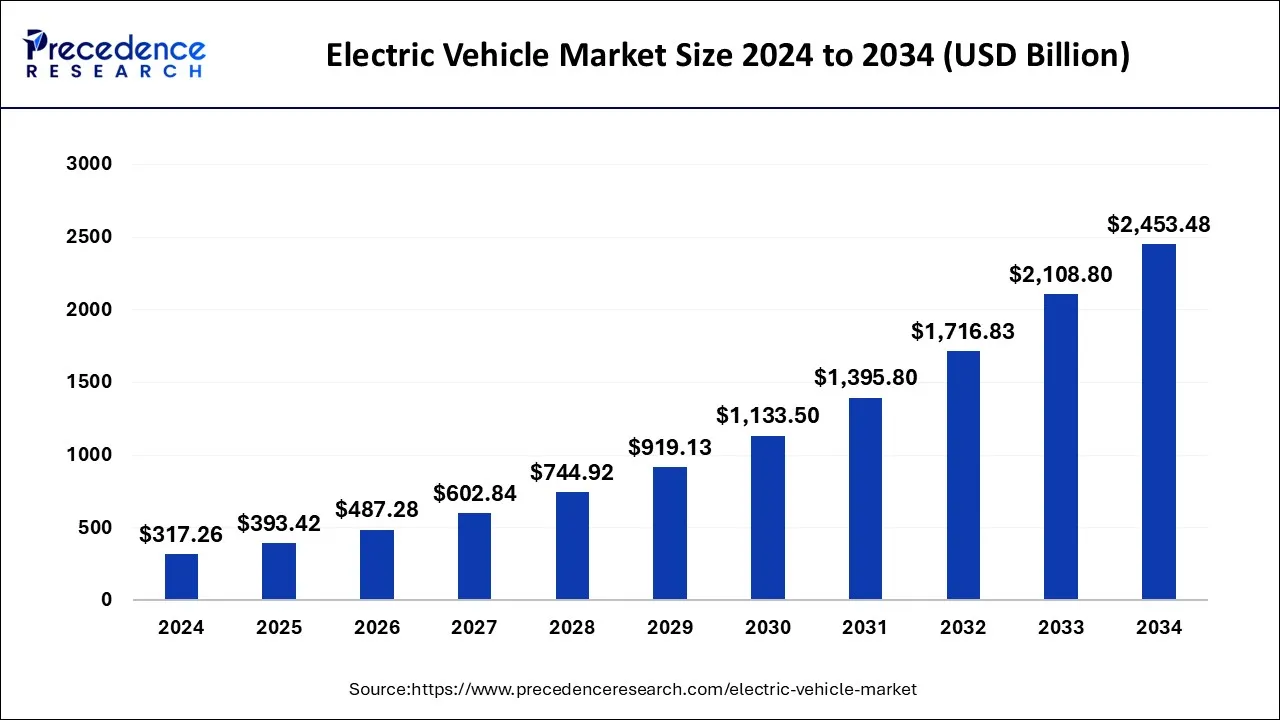
Electric Vehicle Market Key Takeaways
- In terms of revenue, the EV market is valued at $988.70 billion in 2025.
- It is projected to reach $2,763.17 billion by 2035.
- The market is expected to grow at a CAGR of 10.82% from 2026 to 2035.
- Asia Pacific dominated the global market with the largest market share of 49% in 2025.
- North America is anticipated to witness the fastest growth in the market during the forecasted years.
- Europe has emerged as a significant player in the global market.
- By Propulsion Type, the Battery Electric Vehicle (BEV) segment held the largest market share in 2025.
- By propulsion type, the Fuel Cell Electric Vehicles (FCEVs) segment is anticipated to show considerable growth in the forecast period.
- By vehicle type, the passenger cars segment dominated with the biggest market share in 2025.
- By vehicle type, the trucks segment is anticipated to show considerable growth over the forecast period.
- By drive type, the Front-wheel Drive (FWD) segment held a significant market share in 2025.
- By drive type, the All-wheel Drive (AWD) segment is anticipated to show considerable growth in the forecast period.
- By vehicle speed, the 100MPH-125MPH segment contributed the highest market share in 2025.
- By vehicle speed, the less than 100 MPH segment is anticipated to show considerable growth in the forecast period.
- By vehicle class, the low-price electric vehicle segment captured the biggest market share in 2025.
- By vehicle class, the mid-price electric vehicle segment is expected to register a moderate CAGR over the forecast period.
- By end-use, the personal segment held the largest market share in 2025.
- By end-use, the commercial segment is projected to witness significant growth in the forecast period.
Electric Vehicle Market Overview
The electric vehicle (EV) market is experiencing rapid growth, driven by increasing environmental concerns, global decarbonization goals, and strong government support. Rising demand for sustainable and high-performance mobility solutions, along with continuous advancements in charging infrastructure, is accelerating EV adoption worldwide. Registrations of electric cars and two-wheelers are growing consistently each year, reflecting a clear shift toward cleaner transportation.
Automotive companies are actively introducing innovative models and investing heavily in EV production to strengthen their market position and align with net-zero emission targets. Government initiatives, including subsidies, tax benefits, and favorable policies, are further encouraging consumers to adopt electric vehicles.
For example, in February 2025, the government of Madhya Pradesh, India, introduced its EV Policy 2025, offering subsidies ranging from ₹5,000 to ₹10 lakh across different vehicle categories. The policy aims to boost EV adoption significantly by 2030, targeting 15% penetration for four-wheelers and 40% for two-wheelers. Such initiatives are playing a key role in accelerating market growth.
Impact of Artificial Intelligence on the Electric Vehicle Market
Artificial Intelligence (AI) is transforming the electric vehicle market by enhancing efficiency, safety, and overall driving experience. AI-powered predictive maintenance systems help detect potential issues early, allowing manufacturers and users to prevent breakdowns and optimize vehicle performance.
AI also plays a crucial role in battery management systems by improving energy efficiency, extending battery life, and increasing driving range. In addition, AI-enabled virtual assistants and infotainment systems provide personalized in-car experiences, making driving more convenient and user-friendly.
The growing demand for autonomous electric vehicles is another major area where AI is making a significant impact. AI technologies support advancements in self-driving capabilities, smart charging systems, and vehicle-to-everything (V2X) communication. These innovations not only improve vehicle performance but also enhance safety and connectivity for both drivers and passengers.
lectric Vehicle Market Growth Factors
- Government Initiatives: A significant number of initiatives taken by the government of various countries, such as tax rebates, subsidies & grants, and other non-financial benefits in car registration and access to carpool lanes expected to drive the sale of electric vehicles. Strict government rules & regulations toward vehicle emigration along with reduction in cost of electric vehicle batteries and adding fuel costs.
- Environmental Concerns: Rising concern over climate change and air pollution is shifting toward adoption of electric vehicles. Stringent environmental regulations and government promotions are fueling adoption range.
- Demand for Self-driving Vehicles: consumers are seeking automated vehicles, fueling developments of automatic-driving electric vehicles for the market. The need for user-friendly, value-added features and the advantages of decreased accident threats are driving the popularity of self-driving vehicles.
- Technological Advancements: The increase in demand for fuel-efficient, high-performance, & low-emission vehicles has surged for technological advancements, including battery advancements, material science, and improvement of range and cost-effectiveness, making electric vehicles a more ideal option for consumers.
- Growth in Charging Infrastructure: Countries are focusing on expanding charging infrastructure, contributing to electric vehicle market growth. Availability of charging stations reduces range anxiety and enables adoption of electric vehicles.
Market Scope
| Report Highlights | Details |
| Market Size in 2025 | USD 988.70 Billion |
| Market Size in 2026 | USD 1,097.46 Billion |
| Market Size by 2035 | USD 2,763.17 Billion |
| Growth Rate from 2026 to 2035 | CAGR of 10.82% |
| Largest Market | Asia Pacific |
| Base Year | 2025 |
| Forecast Period | 2026 to 2035 |
| Segments Covered | Propulsion Type, Components, Vehicle Type, Vehicle Class, Top Speed, Vehicle Drive, EV Charging Point Type, V2G, and Region |
| Regions Covered | North America, Europe, Asia-Pacific, Latin America and Middle East & Africa |
Electric Vehicle Market Dynamics
Driver
Global Net-Zero Commitments
The global net-zero commitments are the major factor contributing to promoting the use of electric vehicles. Governments and companies have shifted their decarbonization emphasis with the adoption of electric vehicles. As air pollution occurring due to fossil fuel-based transportation has become a major concern, the shift to electric vehicles has taken opportunities. Government policies for electric vehicle adoption further fuel market expansion. Technological advancements are improving performance, range, and cost-effectiveness, making electric vehicles an ideal solution for consumers. Sustainability trends are making electric vehicles competitive with traditional vehicles, aligning with consumers increased demand for sustainable solutions.
Restraint
Battery Longevity and Replacement Costs
Battery longevity and replacement cost are the major hindrances to the adoption of electric vehicles. Battery degradation and limited driving range influence consumer experiences as well as expenses. Battery longevity concerns hamper electric vehicle adoption for long-distance travel, as they cause a risk of “range anxiety” for potential EV buyers. The high upfront cost and uncertainty around replacement cost have a high impact on the purchasing range.
Opportunity
Development of Charging Infrastructure
Limitation of changing infrastructure was the major restraint in the electric vehicle market. However, increased government and key vendor initiatives and investments in the development of advanced charging infrastructure are enabling high adoption of electric vehicles in various countries. Globally, government bodies are taking the initiative to improve strategies and programs to develop rapid charging infrastructure. Several investments are taking place worldwide to expand commercial charging to support HDVs. For instance, through direct investment, California and a few other US regions are promoting the construction of the infrastructure needed for electric HDVs.
The largest hydrogen refueling network in North America has been supported by the California Energy Commission (CEC) with more than USD 125 million for 62 public stations as part of the state’s ambition to establish 200 stations by 2025. Investments have been primarily focused exclusively on LDV refueling infrastructure till 2020. A plan to allocate up to USD 115 million more for hydrogen refueling infrastructure, including fueling for medium- and heavy-duty trucks, was approved later in December 2020. Thus, these initiatives by the government will create lucrative opportunities for the electric vehicle industry.
- In February 2024, Hyundai Motor India expanded its ultra-fast EV charging network with 11 new stations, providing quick and convenient 24/7 charging using advanced technology. The MyHyundai app allows users to discover, navigate, pre-book slots, make payments, and monitor status. Future plans include installing 100 stations by 2027.
V2G Technology
Vehicle-to-Grid (V2G) technology is the novel approach in the electric vehicle market. The technology allows electric vehicles to supply electricity back to the grid and helps to maintain energy storage and grid stabilization. Bidirectional energy transfer application of V2G technology improves grid reliability and optimizes energy distribution. V2G technology is significant in enhancing renewable energy integration, reducing grid cost, and improving efficiency, making electric vehicles more efficient, high-performing, sustainable, and affordable. V2G technology is also driving innovation in battery technology and charging infrastructure, with improving efficiency, extending lifespan, and biodegradability.
Regional Insights
Asia-Pacific dominates the electric vehicle market, driven by strong government support, large-scale manufacturing capabilities, and rising consumer demand for affordable mobility solutions. Countries like China, India, Japan, and South Korea are leading adoption through subsidies, favorable policies, and investments in charging infrastructure. China, in particular, plays a central role as both the largest producer and consumer of EVs. The rapid growth of electric two-wheelers and public transportation electrification in emerging economies is further accelerating market expansion across the region.
North America is witnessing strong growth, supported by increasing investments in EV manufacturing, battery technology, and charging networks. The United States and Canada are focusing on reducing carbon emissions through incentives, tax credits, and infrastructure development. Automakers are expanding their EV portfolios, while consumers are showing growing interest in high-performance electric SUVs and trucks. The region is also advancing in autonomous driving technologies, further boosting EV adoption.
Europe is a key market for electric vehicles, driven by strict emission regulations, sustainability goals, and strong government incentives. Countries such as Germany, the UK, France, and Norway are actively promoting EV adoption through subsidies, tax benefits, and bans on internal combustion engine vehicles in the long term. The region is also a leader in EV charging infrastructure and battery innovation, with a strong focus on achieving carbon neutrality and supporting green mobility initiatives.
Electric Vehicle Market Companies
- BYD Company Limited: BYD Company Limited is thus offering a comprehensive lineup of battery electric vehicles (BEVs) along with plug-in hybrids (PHEVs), featuring proprietary Blade Battery technology, e-Platform 3.0, as well as advanced DM-i hybrid systems. They aim for affordable, high-safety, and even high-efficiency electric transportation, thus spanning passenger cars to commercial buses and trucks, with operations in over 100 countries.
- Chevrolet Motor Company: Chevrolet provides a growing lineup of electric vehicles driven by the versatile Ultium battery platform, impacting long range, fast charging, and competitive pricing.
- Energica Motor Company S.p.A.: Energica Motor Company S.p.A. provides high-performance electric motorcycles and even advanced, proprietary EV powertrain technologies for both two-wheelers and a few electric mobility applications.
- Ford Motor Company: Ford Motor Company is investing $22 billion by 2025 in electric vehicles, aiming on popularizing icons with models such as the F-150 Lightning truck, Mustang Mach-E SUV, and even E-Transit van. They are shifting toward more affordable, smaller EVs through a new dedicated platform, targeting a $30,000 price point by 2027 to compete with Tesla and Chinese automakers.
Recent Developments
- In January 2025, Maruti Suzuki announced the launch of its first electric SUV, the e Vitara, at the Bharat Mobility Global Auto Expo. This launch is expected to be held till the end of April.
- On April 16, 2025, the title of 2025 World Electric Vehicle was given to the Hyundai INSTER at the globally renowned 2025 World Car Awards ceremony, held during the New York International Auto Show (NYIAS).
- On April 22, 2025, Renault announced the launch of two next-gen cars and two new SUVs based on a new platform.
Segment Covered in the Report
By Vehicle Type
- Scooters
- Motorcycles
- Three-Wheelers
- Passenger Cars
- Buses
- Trucks
By Propulsion Type
- Battery Electric Vehicle (BEV)
- Plug-in Hybrid Electric vehicle (PHEV)
- Fuel Cell Electric Vehicle (FCEV)
By Drive Type
- Front-wheel Drive (FWD)
- Rear-wheel Drive (RWD)
- All-wheel Drive (AWD)
By Vehicle Speed
- Less Than 100 MPH
- 100MPH to 125MPH
- Above 125 MPH
By Vehicle Class
- Low Priced
- Mid-Price
- High Price
By End Use
- Personal
- Commercial
By Geography
- North America
- Asia Pacific
- Europe
- Latin America
- Middle East & Africa
Get Sample Link: https://www.precedenceresearch.com/sample/1009
Also Read : https://www.businesswebwire.com/molded-interconnect-device-market/