
What is the Contrast Media Market Size in 2026?
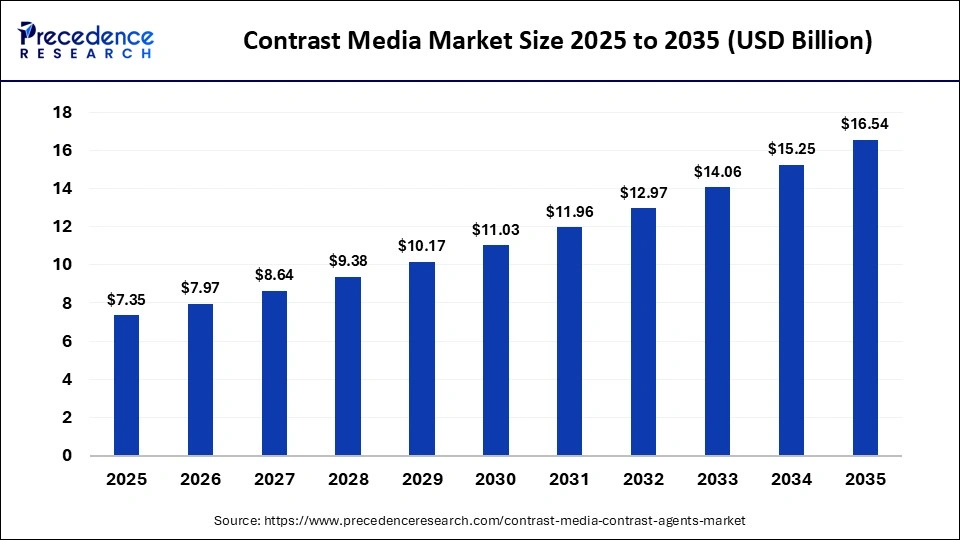
The global contrast media market size was calculated at USD 7.35 billion in 2025 and is predicted to increase from USD 7.97 billion in 2026 to approximately USD 16.54 billion by 2035, expanding at a CAGR of 8.45% from 2026 to 2035. The market is driven by the growing demand for advanced diagnostic imaging procedures, including MRI, CT, and X-ray, fueled by rising prevalence of chronic diseases and technological innovations in imaging agents.
Key Takeaways
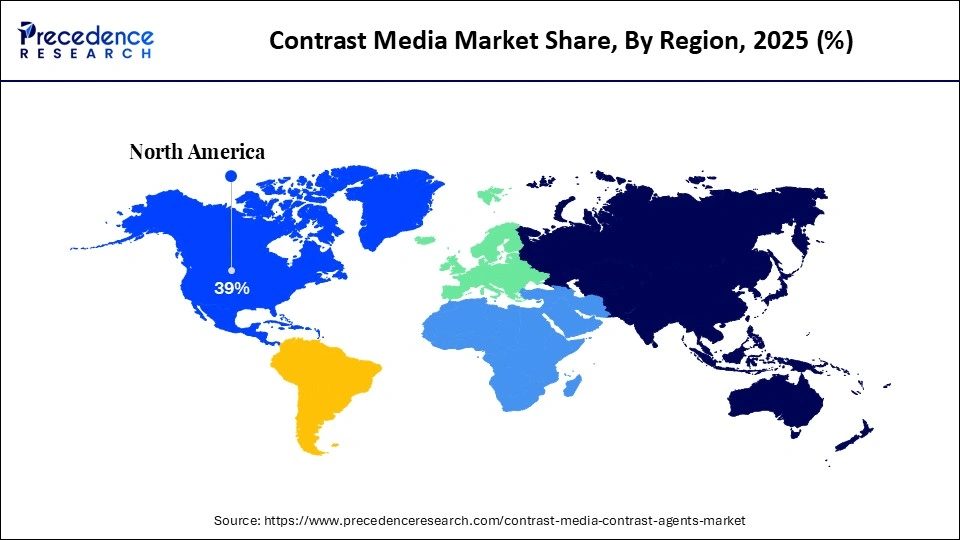
- North America dominated the contrast media market share of 39% in 2025.
- Asia Pacific is expected to grow at the fastest rate over the forecast period.
- By modality type, the x-ray/computed tomography segment held the largest market share in 2025.
- By modality type, the ultrasound segment is expected to grow at the fastest rate over the forecast period.
- By product, the Iodinated segment dominated the market in 2025.
- By product, the microbubble segment is expected to expand at the fastest CAGR over the forecast period.
- By application, the neurological disorders segment accounted for the largest share of the market in 2025.
- By application, the cardiovascular disorders segment is projected to grow at a significant rate over the forecast period.
- By route of administration, the intravenous segment led the market in 2025 and is observed to grow at the fastest rate in the foreseeable period.
- By end use, the hospitals segment led the market in 2025.
- By end use, the diagnostic imaging centers segment is observed to expand at the fastest CAGR in the foreseen period.
Contrast Media Market Overview
The contrast media market focuses on specialized chemical agents used in medical imaging to enhance the visibility and differentiation of internal body structures. These agents improve contrast resolution, enabling more accurate detection and characterization of various diseases and pathological conditions.
Different types of contrast media are designed for specific imaging modalities such as MRI, CT scans, and ultrasound, as well as for different routes of administration. Continuous innovation is leading to the development of advanced agents, including high-relaxivity gadolinium-based compounds and emerging manganese-based alternatives with strong commercial potential. The increasing number of diagnostic imaging procedures worldwide, particularly MRI and ultrasound scans, is a key factor driving market growth.
Impact of Artificial Intelligence on the Contrast Media Market
Artificial intelligence (AI) is playing a crucial role in transforming the contrast media market by improving diagnostic accuracy, enhancing imaging workflows, and supporting patient safety. AI-powered tools enable personalized contrast administration by optimizing dosage based on patient-specific characteristics, reducing unnecessary exposure and associated risks.
Additionally, AI-driven radiomics allows for advanced, non-invasive analysis of imaging data, helping in disease detection, prognosis assessment, and treatment monitoring. The integration of AI with contrast media technologies is fostering innovation, improving clinical outcomes, and enabling more precise and efficient diagnostic practices.
Key Trends in the Contrast Media Market
- Advancements in Next-Generation Contrast Agents: Ongoing innovation in MRI contrast agents, including nanoparticle-based formulations, manganese-based compounds, and macrocyclic gadolinium agents, is significantly enhancing imaging precision and driving technological progress.
- Focus on Patient Safety and Cost Efficiency: Manufacturers are increasingly focusing on developing safer and more cost-effective contrast agents, particularly for sensitive patient groups such as pregnant or breastfeeding individuals, while maintaining high diagnostic performance.
- Integration of AI with Imaging Technologies: The combination of AI with advanced contrast media is improving image analysis, optimizing contrast dosing, and enhancing diagnostic accuracy, thereby accelerating the adoption of intelligent imaging solutions across healthcare systems.
Market Scope
| Report Coverage | Details |
| Market Size in 2025 | USD 7.35 Billion |
| Market Size in 2026 | USD 7.97 Billion |
| Market Size by 2035 | USD 16.54 Billion |
| Market Growth Rate from 2026 to 2035 | CAGR of 8.45% |
| Dominating Region | North America |
| Fastest Growing Region | Asia Pacific |
| Base Year | 2025 |
| Forecast Period | 2026 to 2035 |
| Segments Covered | Modality Type, Product, Application, Route of Administration, End Use, and region |
| Regions Covered | North America, Europe, Asia-Pacific, Latin America, and Middle East & Africa |
Regional Insights
North America dominates the contrast media market due to the high volume of diagnostic imaging procedures and the presence of advanced healthcare infrastructure. The region benefits from strong adoption of MRI, CT, and ultrasound technologies, along with continuous innovation in contrast agents. Increasing integration of AI in radiology and a growing focus on personalized imaging protocols are further driving market growth.
Europe holds a significant position in the market, supported by well-established healthcare systems and strict regulatory frameworks ensuring patient safety. Countries such as Germany, the UK, and France are investing in advanced imaging technologies and safer contrast agents. The region is also witnessing increased adoption of macrocyclic and low-risk contrast media, along with rising use of AI-driven imaging solutions.
Asia-Pacific is the fastest-growing region, driven by expanding healthcare infrastructure, rising diagnostic imaging demand, and increasing awareness of early disease detection. Countries like China, India, and Japan are experiencing a surge in imaging procedures, supported by growing healthcare investments and improving access to advanced technologies. The adoption of cost-effective contrast agents is also contributing to market expansion.
Contrast Media Market Value Chain Analysis
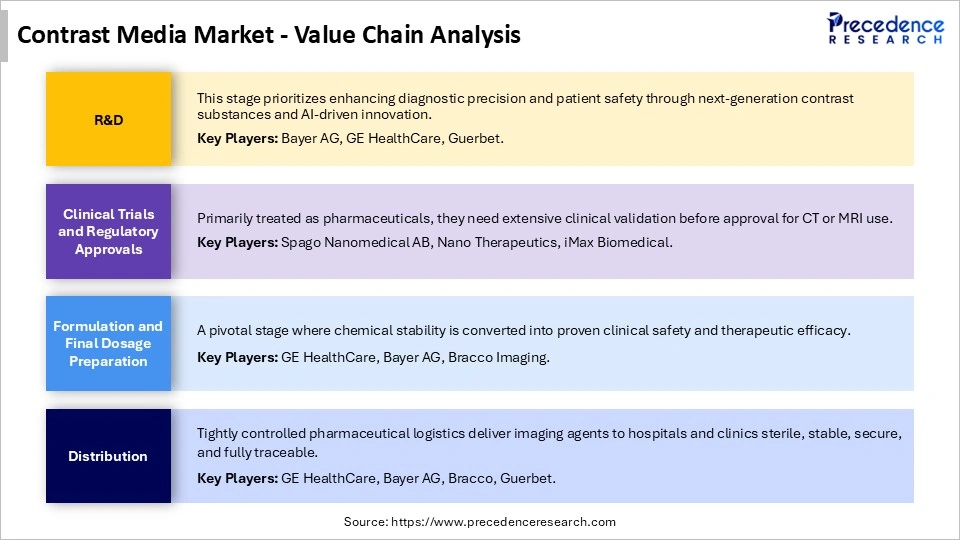
Contrast Media Market Companies
- GE HealthCare (USA)
- Bayer AG (Germany)
- Bracco Imaging S.p.A. (Italy)
- Guerbet (France)
- Lantheus Medical Imaging (USA)
- Daiichi Sankyo Company, Ltd. (Japan)
- Fujifilm Holdings Corporation (Japan)
- Jiangsu Hengrui Medicine Co., Ltd. (China)
- J.B. Chemicals & Pharmaceuticals Ltd. (India)
- Fresenius Kabi (Germany)
- Subhra Pharma Private Limited (India)
- Taejoon Pharm Co., Ltd. (South Korea)
- iMax Biomedical (USA)
- Nano Therapeutics (UK)
- Beijing Beilu Pharmaceutical Co., Ltd. (China)
Segment Covered in the Report
By Modality Type
- Ultrasound FG
- Magnetic Resonance Imaging
- X-ray/Computed Tomography
By Product
- Microbubble
- Gadolinium-Based
- Iodinated
- Barium-Based
By Application
- Cardiovascular Disorders
- Neurological Disorders
- Gastrointestinal Disorders
- Cancer
- Nephrological Disorders
- Musculoskeletal Disorders
- Others
By Route of Administration
- Intravenous
- Oral Route
- Rectal Route
By End Use
- Hospitals
- Diagnostic Imaging Centers
- Others
By Region
- North America
- Latin America
- Europe
- Asia-pacific
- Middle and East Africa