
What is the Composite AI Market Size in 2026?
The global composite AI market size was accounted for USD 1.72 billion in 2025 and is predicted to increase from USD 2.29 billion in 2026 to approximately USD 29.57 billion by 2035, expanding at a CAGR of 32.90% from 2026 to 2035. The market is rapidly expanding due to the growing need to solve intricate and real-world problems with multimodal AI systems across diverse industries amid accelerating data complexity.
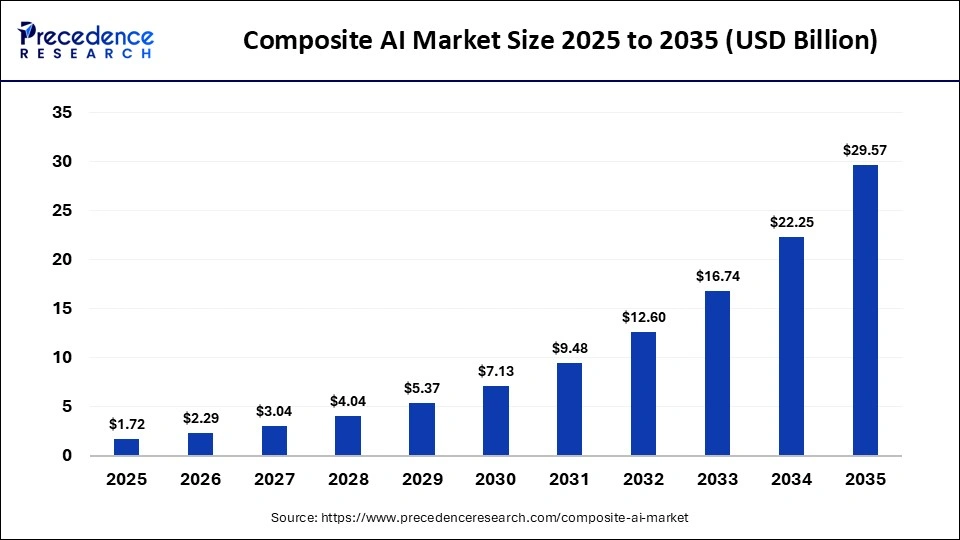
Key Takeaways
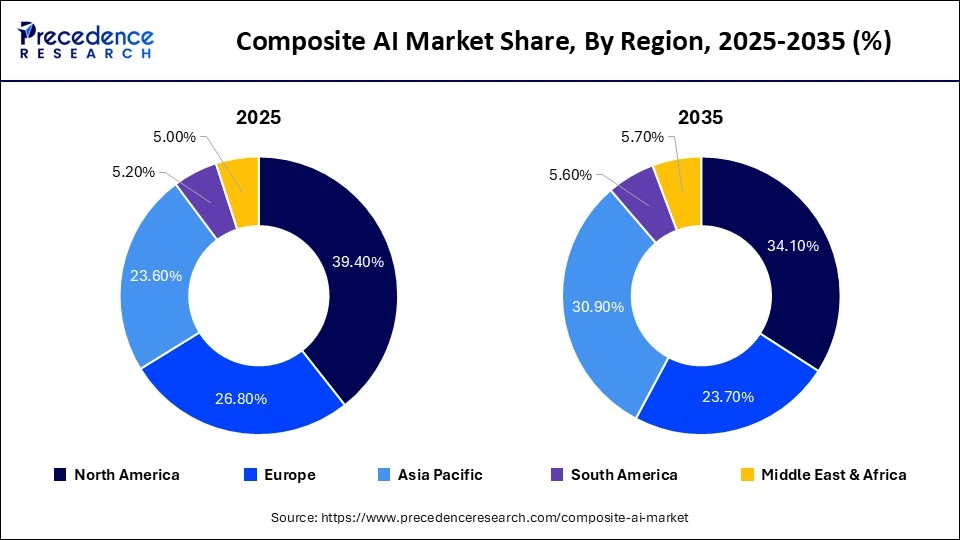
- North America held the largest market share of 39.4% in 2025.
- The Asia Pacific is expected to witness the fastest growth between 2026 and 2035.
- By component, the software segment held the largest market share of 71.8% in 2025.
- By component, the services segment is expected to register the fastest CAGR during the foreseeable period.
- By technology type, the machine learning segment led the market with a 22.7% share in 2025.
- By technology type, the knowledge graphs segment is expected to grow at the fastest CAGR during the foreseeable period.
- By AI architecture, the embedded composite AI within enterprise application segment held the largest market share of 43.8% in 2025.
- By AI architecture, the AI orchestration and decision intelligence platforms segment is expected to grow at the fastest CAGR during the foreseeable period.
- By application, the predictive analytics segment held a 19.8% share in 2025.
- By application, the decision intelligence segment is expected to witness the fastest growth during the foreseeable period.
- By end use industry, the BFSI segment held a 18.7% share in 2025.
- By end use industry, the healthcare segment is expected to grow at the fastest CAGR during the foreseeable period.
Market Overview
The composite AI market encompasses a wide range of platforms, tools, and services that integrate multiple artificial intelligence technologies, including machine learning, deep learning, natural language processing (NLP), knowledge graphs, rule-based systems, optimization, and automation. By combining these diverse capabilities, composite AI enables organizations to address complex business challenges through unified and intelligent systems, rather than relying on a single-model approach.
These integrated AI solutions are widely applied across use cases such as advanced analytics, forecasting, decision support, process automation, personalization, risk management, and enterprise workflow orchestration. Composite AI empowers enterprises to enhance operational efficiency, improve decision accuracy, and deliver more adaptive and context-aware outcomes across industries.
The growing importance of composite AI is driven by the increasing need for explainable, scalable, and transparent AI systems that can operate effectively in complex decision-making environments. Organizations are shifting away from isolated AI deployments toward integrated frameworks that combine statistical modeling, semantic reasoning, and automated decision processes. This evolution is particularly significant in data-intensive and decision-driven sectors such as financial services, healthcare, manufacturing, retail, and telecommunications.
Over the forecast period, the adoption of decision intelligence platforms, hybrid deployment models, and enterprise-wide cognitive workflows is expected to accelerate. Businesses are increasingly prioritizing solutions that deliver measurable productivity gains, improved governance, and enhanced business outcomes, positioning composite AI as a critical component of next-generation enterprise transformation.
Composite AI Market Trends
- The growing adoption of explainable AI (XAI) is boosting the growth of the market.
- Composite AI is increasingly deployed in high risk sectors like finance and healthcare.
- There is a rapid shift toward AI approaches, where multiple techniques, such as machine learning, knowledge graphs, and optimization methods, are combined. This enables businesses to generate more accurate, contextual, and reliable insights compared to relying on a single AI model.
- Another notable trend is the rising adoption of low code and no code AI platforms, which are democratizing access to advanced AI capabilities. These platforms allow enterprises to design, build, and deploy sophisticated composite AI solutions without requiring deep technical expertise.
- Composite AI is being widely used across industries for real-time data processing across multiple data streams, making it highly effective for use cases such as fraud detection, predictive maintenance, and enhancing overall operational efficiency.
Market Scope
| Report Coverage | Details |
| Market Size in 2025 | USD 1.72 Billion |
| Market Size in 2026 | USD 2.29 Billion |
| Market Size by 2035 | USD 29.57 Billion |
| Market Growth Rate from 2026 to 2035 | CAGR of 32.90% |
| Dominating Region | North America |
| Fastest Growing Region | Asia-Pacific |
| Base Year | 2025 |
| Forecast Period | 2026 to 2035 |
| Segments Covered | Component, Technology Type, AI Architecture, Application, End Use Industry, and Region |
| Regions Covered | North America, Europe, Asia-Pacific, Latin America, and Middle East & Africa |
Regional Insights
North America dominates the composite AI market, accounting for the largest revenue share, driven by a mature digital ecosystem and strong enterprise adoption of advanced AI technologies.
The United States leads the region due to its robust technology infrastructure, high investment in AI research and development, and presence of major tech companies. Enterprises across industries such as finance, healthcare, and manufacturing are rapidly deploying composite AI solutions to enhance decision-making, automation, and personalization.
Additionally, strong cloud infrastructure, government support, and innovation-focused policies continue to accelerate market growth in the region.
Europe holds a significant share of the composite AI market, supported by its emphasis on data privacy, regulatory compliance, and ethical AI frameworks. The region accounted for over 26% of global revenue in 2024.
Countries such as Germany, the UK, and France are key contributors, with increasing adoption of composite AI in sectors like automotive, energy, and public services. The integration of symbolic AI with machine learning is particularly strong in Europe, as organizations prioritize explainability and transparency to comply with strict regulations.
EU-funded initiatives and collaborative research programs further support innovation and deployment across the region.
Asia-Pacific is expected to witness the fastest growth in the composite AI market, with a CAGR exceeding 31% during the forecast period.
Rapid digital transformation, expanding data ecosystems, and increasing government investments in AI strategies are key growth drivers. Countries such as China, India, and Japan are leading adoption, leveraging composite AI to improve operational efficiency and decision intelligence across industries.
The region also benefits from a growing startup ecosystem, rising enterprise AI adoption, and increasing demand for scalable and cost-effective AI solutions.
Latin America is gradually emerging as a promising market for composite AI, driven by increasing digitalization and adoption of AI technologies across sectors such as banking, retail, and telecommunications.
Countries like Brazil and Mexico are witnessing growing investments in AI-driven automation and analytics solutions. However, challenges such as limited infrastructure, skill gaps, and budget constraints may slow adoption compared to developed regions.
Composite AI Market Key Players
- Microsoft Corporation
- International Business Machines Corporation
- Google LLC
- Amazon Web Services, Inc.
- Oracle Corporation
- SAP SE
- SAS Institute Inc.
- Salesforce, Inc.
- NVIDIA Corporation
- C3.ai, Inc.
- DataRobot, Inc.
- H2O.ai, Inc.
- Palantir Technologies Inc.
- FICO
- Infosys Limited
Recent Developments
- In March 2026, the AI-driven SIEM purpose-built for lean security teams, Graylog, has launched new advancements in explainable AI and automated investigation workflow, aiming to enable SMEs’ security teams to build a threat detection and investigation system driven by AI.
- In March 2026, a leading tech player, HackerOne, introduced Agentic Prompt Injection Testing, a new feature to detect real-world exploitability of AI systems. The move addresses rising concerns over the sharp increase in prompt injection vulnerabilities.
- In October 2025, CompositesAI was launched by AnalySwift LLC in collaboration with Purdue University. The platform enables faster design and analysis of composite materials, simplifying development without requiring deep technical expertise.
Segments Covered in the Report
By Component
- Software
- Services
By Technology Type
- Machine Learning
- Deep Learning
- Natural Language Processing
- Knowledge Graphs
- Rule Based Systems
- Optimization and Search
- Computer Vision
- Context Aware and Reasoning Systems
By AI Architecture
- Standalone Composite AI Platforms
- Embedded Composite AI within Enterprise Applications
- AI Orchestration and Decision Intelligence Platforms
By Application
- Predictive Analytics
- Prescriptive Analytics
- Decision Intelligence
- Business Process Automation
- Customer Experience and Personalization
- Fraud Detection and Risk Analytics
- Supply Chain and Operations Optimization
- Workforce Intelligence
By End Use Industry
- Banking, Financial Services, and Insurance
- Healthcare
- Retail and E commerce
- Manufacturing
- IT and Telecommunications
- Government and Defense
- Media and Entertainment
- Transportation and Logistics
- Energy and Utilities
- Others
By Region
- North America
- Latin America
- Europe
- Asia-pacific
- Middle and East Africa
Get Sample Link: https://www.precedenceresearch.com/sample/8241
Also Read : https://www.businesswebwire.com/ai-code-tools-market/