
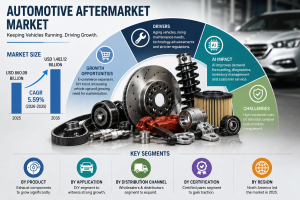
The global automotive aftermarket size was estimated at USD 860.08 billion in 2025 and is projected to surpass USD 1,482.12 billion by 2035, growing at a CAGR of 5.59% from 2026 to 2035. Market expansion is being driven by increasing vehicle ownership, a rising average age of vehicles, growing consumer demand for maintenance services, and the integration of advanced technologies into automotive components.
The global automotive industry does not end when a vehicle leaves the showroom floor. In fact, one of the most dynamic and profitable phases of a vehicle’s lifecycle begins after the original sale. The automotive aftermarket has evolved into a massive ecosystem that supports vehicle maintenance, repair, customization, and performance enhancement, ensuring that millions of vehicles remain operational, safe, and efficient for years.
Market Highlights
- North America dominated the global automotive aftermarket in 2025, accounting for 35.05% of total market revenue.
- The exhaust components segment is expected to witness considerable growth during the forecast period.
- The DIY application segment is anticipated to expand significantly in the coming years.
- Wholesalers and distributors are projected to remain a major distribution channel across the market.
- Certified automotive parts are expected to gain increasing traction among consumers and repair facilities.
The Automotive Aftermarket Has Become a Lifecycle Economy
The traditional perception of the automotive aftermarket as merely a replacement parts industry is rapidly changing. Today, it represents an extensive lifecycle economy that supports vehicles long after their original purchase. Consumers increasingly seek solutions that improve vehicle performance, enhance comfort, maintain safety standards, and extend operational life.
Independent manufacturers and service providers offer a wide range of components, accessories, repair services, and upgrades, often at competitive prices compared to original equipment manufacturers. This flexibility provides consumers with greater choice while fostering innovation throughout the supply chain. As vehicles remain on the road longer than ever before, the importance of the aftermarket continues to expand.
Older Vehicles Are Becoming the Market’s Biggest Opportunity
One of the most significant factors shaping the future of the automotive aftermarket is the rising age of the global vehicle fleet. Consumers are keeping their vehicles for longer periods due to economic considerations, improvements in vehicle durability, and increasing confidence in long-term reliability.
As vehicles age, the frequency of maintenance requirements naturally increases. Components such as exhaust systems, braking assemblies, suspension systems, filters, and electronic parts require periodic replacement to ensure optimal performance. This trend creates a consistent stream of demand that provides resilience to the aftermarket, even during periods of uncertainty in new vehicle sales.
The increasing number of aging vehicles effectively transforms maintenance from an occasional expense into an essential aspect of vehicle ownership, strengthening the long-term outlook for the industry.
Consumers Are Investing More in Comfort and Personalization
Modern vehicle owners are increasingly viewing their automobiles as extensions of their lifestyles rather than simple transportation tools. This shift has fueled demand for accessories and modifications that improve convenience, comfort, aesthetics, and driving experiences.
Features once considered luxury upgrades are becoming mainstream expectations. Consumers seek personalized enhancements that align with their preferences, creating opportunities for aftermarket businesses to offer innovative solutions tailored to evolving tastes. Rising disposable incomes in many regions further support spending on customization and premium vehicle upgrades.
This emotional connection between consumers and their vehicles is redefining the aftermarket from a necessity-driven market into an experience-oriented industry.
Environmental Regulations Are Driving Product Innovation
Governments around the world continue to implement stringent environmental regulations aimed at reducing vehicle emissions and controlling noise pollution. These standards are compelling manufacturers to develop more efficient and environmentally responsible automotive components.
The demand for advanced exhaust systems, improved emission-control technologies, and components that contribute to better fuel efficiency has grown substantially. Consumers seeking to comply with regulatory requirements while maintaining vehicle performance increasingly rely on aftermarket solutions designed to meet evolving standards.
Rather than restricting growth, these regulations are encouraging technological innovation and creating new opportunities for businesses capable of delivering compliant, high-performance products.
Digital Transformation Is Reshaping How Consumers Buy Parts
Perhaps one of the most profound changes within the automotive aftermarket is the rapid rise of digital commerce. Today’s consumers conduct extensive online research before making purchasing decisions, comparing prices, reading reviews, watching installation videos, and evaluating product performance through multiple channels.
E-commerce has significantly improved accessibility and transparency within the industry. Consumers can identify suitable products more efficiently, while businesses can reach broader audiences without relying solely on traditional retail networks. The convenience of mobile shopping and online ordering has accelerated this transition, particularly among younger and digitally engaged consumers.
The growing influence of digital platforms is transforming customer expectations and forcing aftermarket participants to rethink how they engage, educate, and support buyers.
Artificial Intelligence Is Revolutionizing the Aftermarket Ecosystem
Artificial intelligence is emerging as one of the most transformative forces in the automotive aftermarket. Rather than functioning solely as a back-office technology, AI is influencing decision-making throughout the value chain.
By analyzing large volumes of sales and operational data, AI enables businesses to forecast demand more accurately and anticipate shifts in purchasing behavior. Inventory optimization becomes more precise, helping distributors reduce excess stock while minimizing shortages. Repair workshops benefit from enhanced diagnostic capabilities that allow technicians to identify faults more quickly and accurately.
Artificial intelligence also supports predictive maintenance strategies by identifying patterns that indicate potential component failures before they occur. This proactive approach reduces downtime, improves customer satisfaction, and contributes to more efficient service delivery. As AI technologies continue to mature, their role within the aftermarket is expected to expand considerably.
Technological Advancements Are Increasing Aftermarket Value
The growing sophistication of modern vehicles has elevated the complexity and value of aftermarket products. Consumers increasingly seek solutions that enhance vehicle efficiency, safety, and functionality, creating demand for technologically advanced components.
The integration of intelligent systems and electronic technologies into vehicles has generated opportunities for businesses capable of supporting these innovations through specialized replacement parts and services. Advanced driver assistance features, connected vehicle technologies, and evolving mobility solutions require new levels of expertise across the aftermarket ecosystem.
As a result, the industry is steadily transitioning from mechanical replacement toward technology-enabled service delivery.
The Shift Toward Electric Vehicles Presents Both Opportunity and Risk
The global transition toward electrified mobility represents a defining challenge for the automotive aftermarket. Electric vehicles contain fewer moving parts than traditional internal combustion engine vehicles, potentially reducing demand for certain categories of replacement components.
However, this transition also creates entirely new opportunities. Electric vehicles require specialized maintenance procedures, battery-related services, thermal management systems, and advanced electronic diagnostics. Businesses capable of adapting their technical capabilities to meet these evolving requirements are likely to secure a competitive advantage.
The challenge lies particularly with smaller players that must invest in training, equipment, and technological expertise to remain relevant within an increasingly electrified automotive landscape.
Rising Operational Costs Continue to Pressure the Industry
Despite favorable growth prospects, the automotive aftermarket faces several operational challenges. The cost of vehicle modifications and premium aftermarket components remains high for many consumers, limiting broader adoption across price-sensitive segments.
At the same time, businesses must manage increasing expenses associated with inventory management, logistics, compliance requirements, and workforce development. Balancing affordability with profitability remains a delicate task, particularly as consumers continue to expect high-quality products at competitive prices.
Organizations capable of improving efficiency through digitalization and streamlined operations are expected to navigate these pressures more successfully.
Data Management Has Become a Strategic Necessity
The growing complexity of automotive components has created another significant challenge for the industry: managing vast quantities of product information accurately.
Modern vehicles contain thousands of interconnected parts, many of which vary by model, production year, and regional specifications. Ensuring that consumers and technicians receive accurate compatibility information is critical to preventing incorrect purchases and installation errors.
As product catalogs continue to expand, effective data management systems are becoming essential tools that support customer confidence, improve operational efficiency, and reduce costly mistakes.
Future Outlook
The automotive aftermarket is entering a transformative period defined by aging vehicles, digital innovation, evolving consumer expectations, and technological disruption. While challenges related to electrification, operational costs, and increasing complexity persist, the industry’s underlying fundamentals remain exceptionally strong.
As vehicle owners seek greater value, convenience, and performance throughout the lifespan of their automobiles, the aftermarket will continue to evolve from a reactive repair industry into a proactive mobility support ecosystem. Businesses that embrace digital transformation, invest in emerging technologies such as artificial intelligence, and adapt to changing mobility trends will be best positioned to capitalize on the opportunities shaping the future of the global automotive aftermarket.
Also Read: Remote Neurological Monitoring Market
Get this report to explore global market size, share, CAGR, and trends, featuring detailed segmental analysis and an insightful competitive landscape overview:https://www.precedenceresearch.com/sample/1111
You can place an order or ask any questions. Please feel free to contact us at sales@precedenceresearch.com |+1 804 441 9344
