What is the Aircraft Turbofan Engine Market Size in 2026?
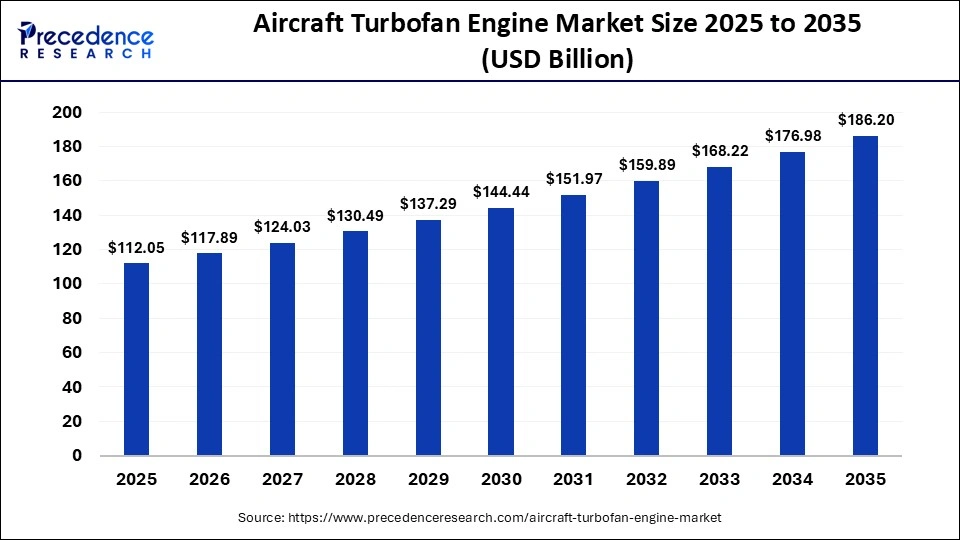
The global aircraft turbofan engine market size accounted for USD 112.05 billion in 2025 and is predicted to increase from USD 117.89 billion in 2026 to approximately USD 186.20 billion by 2035, expanding at a CAGR of 5.21% from 2026 to 2035. The market is experiencing unprecedented growth, driven by a rise in air travel demand and significant investments in advanced materials.
Key Takeaways
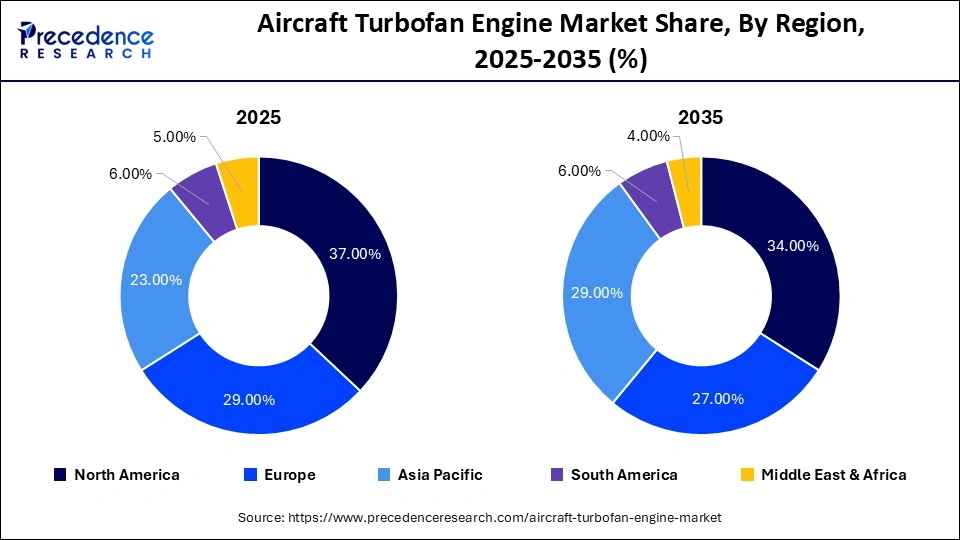
- North America held the largest market share of 37% in 2025.
- Asia Pacific is expected to expand at the fastest CAGR between 2026 and 2035.
- By engine type, the high bypass turbofan segment held the largest market share of approximately 60% in 2025.
- By engine type, the geared turbofan (GTF) segment is expected to grow at the fastest CAGR between 2026 and 2035.
- By component, the fan & compressor segment contributed a major share of approximately 30% in the market in 2025.
- By component, the gearbox segment is expected to expand at the fastest growth rate between 2026 and 2035.
- By application, the commercial aviation segment held a dominant market share of approximately 68% in 2025.
- By application, the business & general aviation segment is expected to grow at the fastest rate from 2026 to 2035.
- By thrust range, the above 50,000 lbf segment held a dominant share of approximately 50% in 2025.
- By thrust range, the 20,000–50,000 lbf segment is expected to grow at the fastest rate from 2026 to 2035.
Market Overview
An aircraft turbofan engine is one of the most widely used engine types in modern aviation. It works by drawing in air through a large fan at the front, where some of the air goes through the engine core while a significant portion bypasses it. This “bypass air” helps generate thrust more efficiently, especially at subsonic speeds.
The engine consists of a central core, a front fan, and an additional turbine at the rear. These components are made up of multiple blades and are connected through shafts, working together to produce power. By combining the efficiency of a propeller with the speed of a turbojet, turbofan engines offer better fuel efficiency by directing most of the airflow around the engine core.
How is AI Impacting the Aircraft Turbofan Engine Market?
Artificial Intelligence (AI) is transforming the aircraft turbofan engine market in several impactful ways. One of the biggest advantages is predictive maintenance. By using AI along with machine learning and IoT sensors, engineers can monitor engine performance in real time and detect potential issues before they lead to failures. This helps reduce downtime and maintenance costs.
AI is also speeding up the design and development process. With the help of generative design tools, manufacturers can create lighter and more efficient engine components. It also improves aerodynamics and helps in selecting the right materials, reducing the time needed to develop new engines.
In addition, AI plays a key role in improving fuel efficiency and reducing emissions. It can optimize flight operations and support the use of advanced materials like superalloys and lightweight composites. These innovations help manufacturers meet increasingly strict environmental regulations while enhancing overall engine performance.
What are the Emerging Trends in the Market?
- Continuous fleet modernization programs across commercial and military aviation are expected to promote the market’s growth during the forecast period.
- The rising adoption of lightweight composite materials and additive manufacturing , which improves durability, performance, and engine efficiency, is expected to accelerate the growth of the market during the forecast period.
- The rising focus on defense modernization has significantly increased the investment in defense and military transport aircraft, bolstering the market’s growth.
- The increasing aftermarket services are expected to contribute to the overall growth of the market. As airlines work to extend the life of existing fleets, the demand for maintenance, repair, and overhaul (MRO) services has increased.
Market Scope
| Report Coverage | Details |
| Market Size in 2025 | USD 112.05 Billion |
| Market Size in 2026 | USD 117.89 Billion |
| Market Size by 2035 | USD 186.20 Billion |
| Market Growth Rate from 2026 to 2035 | CAGR of 5.21% |
| Dominating Region | North America |
| Fastest Growing Region | Asia-Pacific |
| Base Year | 2025 |
| Forecast Period | 2026 to 2035 |
| Segments Covered | Engine Type, Application, Component, Thrust Range, and Region |
| Regions Covered | North America, Europe, Asia-Pacific, Latin America, and Middle East & Africa |