
What is the AI In Endoscopy Market Size in 2026?
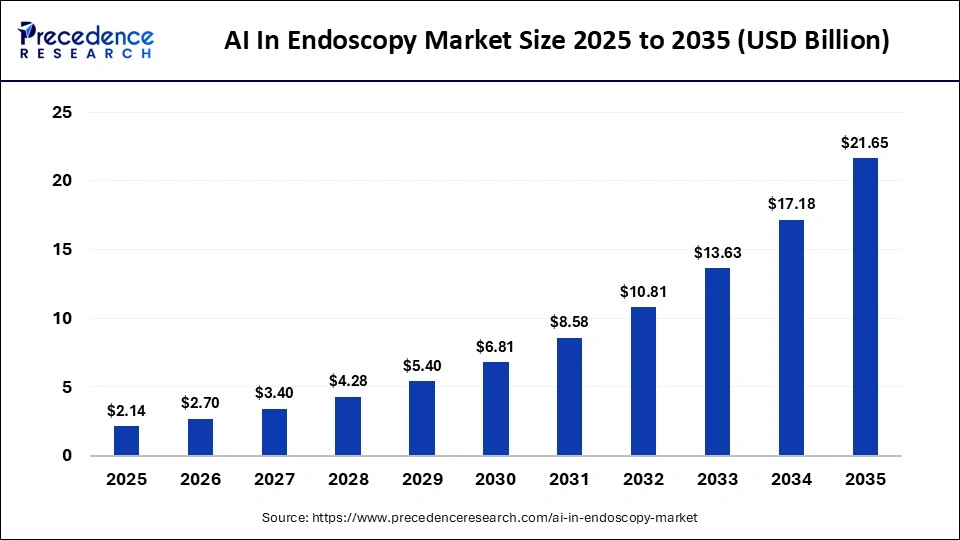
The global AI in endoscopy market size was calculated at USD 2.14 billion in 2025 and is predicted to increase from USD 2.70 billion in 2026 to approximately USD 21.65 billion by 2035, expanding at a CAGR of 26.04% from 2026 to 2035. Market growth is attributed to the increasing adoption of AI-assisted endoscopy systems that enhance diagnostic accuracy and workflow efficiency in hospitals worldwide.
Regional Insights
North America AI In Endoscopy Market Size and Growth 2026 to 2035
The North America AI In Endoscopy Market market size is estimated at USD 963.00 million in 2025 and is projected to reach approximately USD 9,850.75 million by 2035, with a 26.18% CAGR from 2026 to 2035.
Why Did North America Retain its Leadership in the AI in Endoscopy Market?
North America led the market in 2025, due to early technology adoption, large healthcare investments, and advanced screening programs across the United States and Canada. This is guided by the guidelines and expert consensus of societies such as the American Society for Gastrointestinal Endoscopy and the American College of Gastroenterology , among others.
U.S. Leading AI-Assisted Endoscopy Adoption in North America
The U.S. is leading the endoscopy adoption in North America, supported by the country’s robust clinical research system and initial regulatory approvals of CADe system usage through the FDA. Professional societies such as the American Society of Gastrointestinal Endoscopy and the American College of Gastroenterology have approved AI-assisted tools to be used in regular practice. This impacted procedural guidelines and clinician training programs nationwide, thus facilitating the market growth in the coming years.
How is Asia-Pacific Growing in the AI in Endoscopy Market?
Asia-Pacific is expected to experience the fastest growth during the predicted timeframe, owing to the increasing prevalence of GI diseases, particularly colorectal and gastric cancer. Increasing healthcare capacity in China, Japan, and South Korea, with national health program focuses on early diagnosis and preventative diagnostics.
The Asia-Pacific region is focusing on the use of AI-assisted colonoscopy in routine screening and surveillance of the colon, with support in terms of clinical integration pending the accumulation of evidence. Furthermore, the Expansion of healthcare expenditure and clinical training programs in the Asia-Pacific is spurring an increased openness to AI workflows.
Which Factors Drive the AI in Endoscopy Market?
The rapid rise in gastrointestinal (GI) disorders and colorectal cancer prevalence is a key driver accelerating the adoption of AI-assisted endoscopy technologies worldwide. Health systems are emphasizing early detection to minimize morbidity and mortality. AI in endoscopy combines machine learning (ML) and deep learning technologies, in particular, computer-aided detection (CADe) and computer-aided diagnosis (CADx) systems, and endoscopic imaging.
AI In Endoscopy Market Growth Factors
- Increasing Integration with Robotic Endoscopy Platforms: Advancements in robotic-assisted procedures are boosting demand for AI algorithms that enhance precision and real-time guidance.
- Expansion of Cloud-Based Endoscopy Solutions: Adoption of cloud-enabled AI platforms is fueling remote diagnostics and centralized data analysis across hospital networks.
- Advancements in Deep Learning Algorithms: Continuous improvements in image recognition and anomaly detection are driving higher adoption of AI systems in routine endoscopy.
AI in Endoscopy Market Trends
- Integration of Cloud-Based AI Platforms and Telemedicine: AI systems based on clouds allow remote monitoring of endoscopic data and provide telemedicine consultation and centralized diagnostics. This tendency enables the growth of the market because hospitals do not need a lot of on-site infrastructure to implement AI tools. Small clinics and smaller markets are also gaining faster with cloud integration, which links more patients to sophisticated diagnostics.
- Growth of AI-Enabled Capsule Endoscopy Solutions: AI-assisted capsule endoscopy is a wireless imaging device with automated lesion detection capabilities and is minimally invasive compared to traditional methods. The market is growing with increased adoption, as clinics need patient-friendly diagnostics with quicker results.
Segmental Insights
Endoscopy Imaging Modalities Insights
How the White-Light Endoscopy Segment Dominated the AI in Endoscopy Market?
The white-light endoscopy segment accounted for the highest revenue share in the market in 2025, as it is the leading diagnostic instrument in GI, urological, and upper GI biopsy in most parts of the world.The extensive use of the technology is supported by the presence of professional societies, including ESGE, ASGE, and UEG. That advise the use of white-light imaging to support the routine surveillance and cancer screening programs. Furthermore, the procedural efficiency, widespread adoption, and guideline support are expected to sustain its dominance in the market.
The fluorescence endoscopy segment is expected to expand rapidly in the market in the coming years, owing to its ability to highlight molecular and vascular tissue characteristics not visible under white-light imaging. The method involves the use of specific fluorophores to increase the contrast of the mucosa, which is used to accurately delineate the tumor margins and reduce unnecessary biopsies. Increasing attention to early cancer diagnosis and individual diagnostics at the global scale is becoming an adoption driver encouraged by the constant advances in multispectral imaging and AI-assisted analysis.
Application Insights
Which Application Segment Dominated the AI in Endoscopy Market?
The gastrointestinal endoscopy segment dominated the market in 2025, due to its support of the highest proportion of clinical endoscopies to detect early cancer and screen the bowel. Colorectal cancer remains a major global health concern, with approximately 154,000 new cases and 54,000 deaths projected for 2025, reflecting a heavy disease burden that drives demand for enhanced diagnostics. Furthermore, the continued accumulation of evidence is expected to support the sustained dominance of GI endoscopy in the coming years.
The urological endoscopy segment is expected to grow at the fastest CAGR in the coming years, owing to the emerging trend in the development of AI technology that assists in imaging and diagnostic guidance of urological cancer and diseases. Urological cancers, including prostate, bladder, and kidney cancers, accounted for about 2.25 million new global cases and over 815,000 deaths in recent burden estimates. This highlights the clinical need to develop better detection tools, such as AI-based endoscopy technology, further boosting the segment growth.
Type of Endoscopes Insights
How the Flexible Endoscopes Segment Dominated the AI in Endoscopy Market?
The flexible endoscopes segment held the largest revenue share in the market in 2025, due to their high quality of visualization and accessibility with the intricate anatomical structures. Their structure makes them navigate through curved and narrow ducts, and both diagnose and perform therapeutic intervention within the same session. Furthermore, the high level of procedural volume and broad clinical use across all endoscopy suites around the globe is expected to boost the demand for this type of endoscopes.
Check this report to: Self Driving Bus Market
For inquiries regarding discounts, bulk purchases, or customization requests, please contact us at sales@precedenceresearch.com
You can place an order or ask any questions. Please feel free to contact us at sales@precedenceresearch.com |+1 804 441 9344