
What is the AI-Driven Image-to-3D Generator Market Size in 2026?
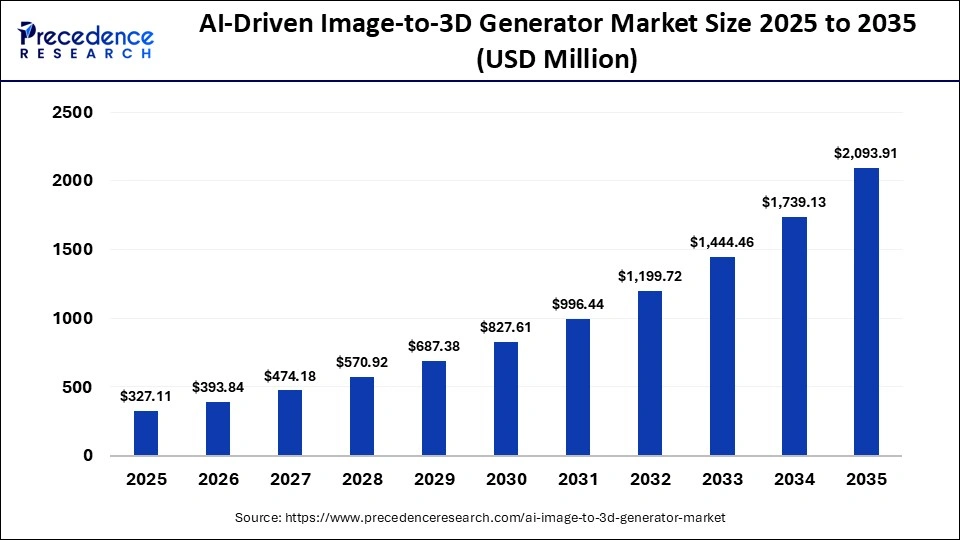
The global AI-driven image-to-3D generator market size was accounted for USD 327.11 million in 2025 and is predicted to increase from USD 393.84 million in 2026 to approximately USD 2,093.91 million by 2035, expanding at a CAGR of 20.40% from 2026 to 2035. The market is experiencing unprecedented growth, driven by rapid technological innovation and increasing investment in AI-driven image generation tools.
Key Takeaways
- North America held the AI-driven image-to-3D generator market with the largest share of 37.8% in 2025.
- Asia Pacific is expected to expand at the fastest CAGR during the forecast period.
- By component, the software platforms segment held the largest market share of 62.4% in 2025.
- By component, the APIs and SDKs segment is expected to grow at the fastest CAGR from 2026 to 2035.
- By input type, the single image segment held a leading position in the market in 2025, accounting for an estimated 46.8% share.
- By input type, the image plus text prompt segment is expected to grow at the fastest rate between 2026 and 2035.
- By output type, the 3D mesh models segment registered its dominance in the global market with a share of 41.7% in 2025.
- By output type, the textured 3D assets segment is expected to grow at a remarkable CAGR between 2026 and 2035.
- By application, the gaming and entertainment segment held a major revenue share of 26.4% in the market in 2025.
- By application, the healthcare and medical visualization segment is set to grow at the fastest CAGR from 2026 to 2035.
Market Overview
The AI-driven image-to-3D generator market includes advanced software platforms, cloud-based tools, APIs, and related services that transform 2D images into high-quality 3D assets using technologies such as generative AI, neural rendering, 3D reconstruction, and geometry synthesis. These solutions generate meshes, textures, point clouds, and full scene representations, enabling seamless integration into applications across gaming, e-commerce, design, industrial prototyping, architecture, education, and healthcare.
The market caters to both enterprise users and individual creators, offering flexible deployment models including cloud, on-premises, and hybrid solutions. Additionally, it encompasses services such as system integration, model training, optimization, and technical support, ensuring efficient adoption and scalability of AI-powered 3D generation tools.
Emerging Trends in the AI-Driven Image-to-3D Generator Market
- Expansion of Generative AI Capabilities: The growing use of generative AI for advanced image processing and transformation is significantly driving market growth. These technologies enable faster and more accurate conversion of 2D images into realistic 3D models.
- Rising Demand for 3D Content Across Industries: The increasing adoption of 3D content in sectors such as gaming and entertainment, architecture and real estate, manufacturing, healthcare visualization, education, and digital marketing is accelerating market expansion.
- Advancements in Deep Learning and Computer Vision: Continuous innovation in deep learning, computer vision, and AI frameworks such as generative adversarial networks (GANs), diffusion models, and 3D Gaussian splatting is enhancing the quality, speed, and realism of 3D model generation.
- Automation of Complex 3D Modeling Processes: AI-driven tools are simplifying the traditionally complex and time-consuming process of 3D modeling. By automating the conversion of 2D images into detailed 3D assets, these solutions reduce dependency on specialized skills and significantly improve efficiency.
- Growing Adoption in VR, AR, and Product Design: The rising demand for high-quality 3D models in virtual reality (VR), augmented reality (AR), gaming, and product design is further fueling market growth, as businesses seek immersive and interactive experiences.
- Shift Toward Hyper-Personalized Content: Increasing consumer demand for personalized digital experiences is boosting the adoption of AI-powered 3D generators. Industries such as fashion, e-commerce, and advertising are leveraging these tools to create customized visuals tailored to specific user preferences and demographics.
Market Scope
| Report Coverage | Details |
| Market Size in 2025 | USD 1.72 Million |
| Market Size in 2026 | USD 2.29 Million |
| Market Size by 2035 | USD 29.57 Million |
| Market Growth Rate from 2026 to 2035 | CAGR of 32.90% |
| Dominating Region | North America |
| Fastest Growing Region | Asia-Pacific |
| Base Year | 2025 |
| Forecast Period | 2026 to 2035 |
| Segments Covered | Component, Technology Type, AI Architecture, Application, End Use Industry, and Region |
| Regions Covered | North America, Europe, Asia-Pacific, Latin America, and Middle East & Africa |
Regional Insights: AI-Driven Image-to-3D Generator Market
North America leads in the adoption of AI-driven image-to-3D generation technologies due to its strong ecosystem of AI startups, cloud service providers, and advanced digital infrastructure. The region benefits from high demand across gaming, entertainment, e-commerce, and industrial design sectors. Companies are increasingly integrating these tools into workflows for faster product visualization, virtual prototyping, and immersive experiences. The presence of major tech firms and continuous investment in generative AI innovation further accelerates market growth.
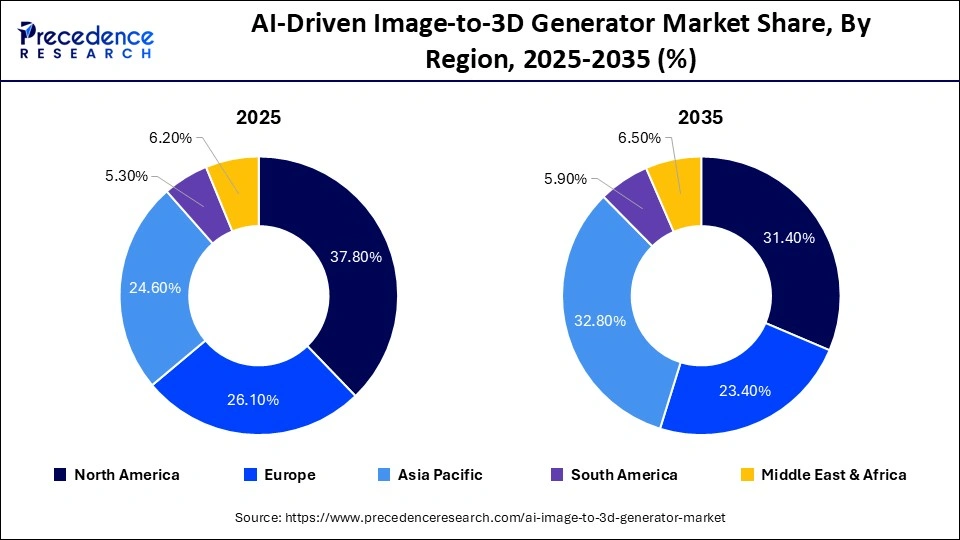
Europe is witnessing steady growth, driven by its focus on precision engineering, industrial design, and digital transformation. Countries in the region are adopting image-to-3D technologies for applications in architecture, automotive design, and manufacturing. Strict regulatory frameworks related to data privacy and AI ethics are shaping the development of compliant and secure solutions. Additionally, the rise of digital twins and smart manufacturing initiatives is boosting adoption across industrial sectors.
Asia-Pacific is emerging as a high-growth region, supported by rapid digitalization, expanding gaming industries, and strong manufacturing capabilities. Countries like China, Japan, and South Korea are heavily investing in AI, 3D content creation, and immersive technologies. The region is also seeing increasing use of these tools in e-commerce, where brands are leveraging 3D visualization to enhance online shopping experiences. Cost-effective development and a large developer base further contribute to market expansion.
AI-Driven Image-to-3D Generator Market Companies
- Adobe Inc .
- Autodesk, Inc.
- NVIDIA Corporation
- Unity Technologies
- Epic Games, Inc.
- Dassault Systèmes SE
- Siemens Digital Industries Software
- Hexagon AB
- Shutterstock, Inc.
- Stability AI Ltd.
- Luma AI
- Kaedim
- Meshy
- Tripo AI
- 3D AI Studio
Recent Developments
- In August 2025, Autodesk, Inc. announced the launch of new and more affordable pricing for Autodesk Flow Studio (formerly Wonder Studio), including its first free tier and a 50% price drop for the Lite plan from $20 to $10, a significant move to make the toolset more accessible. By eliminating high upfront costs, artists can use premium artificial intelligence (AI) powered 3D tools to create the kind of animation and VFX once reserved for Hollywood. Autodesk is witnessing a new era of AI within the future of media and entertainment, one that puts creators at the forefront.
- In February 2026, Tripo AI announced the expanded deployment of its generative infrastructure across the U.S., concurrent with the adoption of its Tripo 3.0 framework by major industry clients. By focusing on algorithmic geometric precision and interactive topology control, the company is focused on standardizing how digital creators and developers integrate automated 3D workflows into various commercial applications.
Segment Covered in the Report
By Component
- Software Platforms
- APIs and SDKs
- Services
By Input Type
- Single Image
- Multi View Image Set
- Image plus Text Prompt
- Image plus Depth or Reference Map
By Output Type
- 3D Mesh Models
- Textured 3D Assets
- NeRF and Gaussian Splatting Scenes
- Point Clouds
- CAD Ready Parametric Models
By Application
- Gaming and Entertainment
- E-Commerce and Retail
- Architecture and Real Estate
- Industrial Design and Manufacturing
- Healthcare and Medical Visualization
- Education and Training
- Advertising and Marketing
- Others
By Region
- North America
- Latin America
- Europe
- Asia-pacific
- Middle and East Africa