
What is the Bioreactors Market Size?
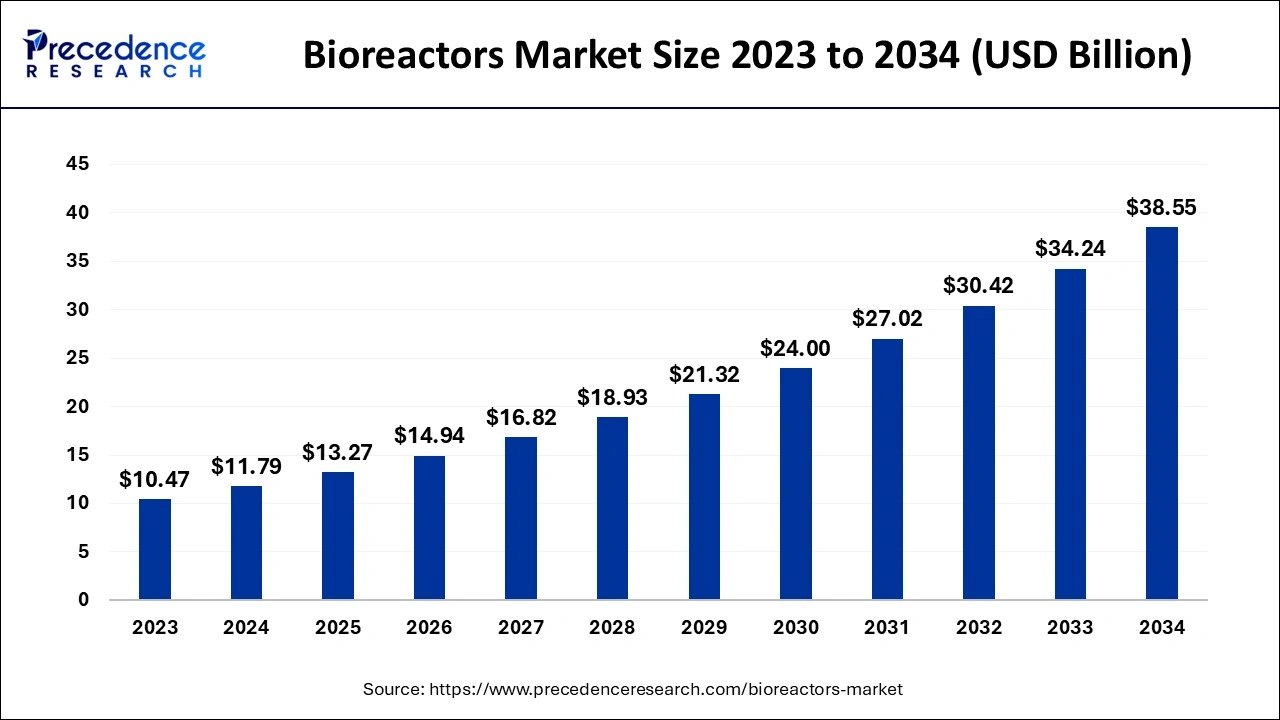
The global bioreactors market was valued at USD 13.27 billion in 2025 and is projected to grow from USD 14.94 billion in 2026 to approximately USD 42.53 billion by 2035, registering a CAGR of 12.35% during the forecast period (2026–2035). Market growth is driven by continuous technological advancements, increasing investments in biomedical research, rising demand for novel biologics, and a growing focus on closed-loop bioprocessing and resource reclamation.
Key Takeaways
- By region, North America led the bioreactors market in 2025.
- By region, Asia-Pacific is expected to grow at the highest CAGR during the forecast period.
- By product type, the reusable bioreactors segment dominated the market with the largest share in 2025.
- By product type, the single-use bioreactors segment is expected to grow the fastest during the forecast period.
- By cell, the mammalian cells segment dominated the market in 2025.
- By cell, the bacterial cells segment is expected to grow rapidly during the forecast period.
- By molecule, the vaccines segment dominated the market in 2025.
- By usage, the commercial production segment dominated the market in 2025.
- By usage, the developmental, preclinical and clinical segment is expected to rise with the highest CAGR during the forecast period.
- By end-use, the biopharmaceutical (biopharma) manufacturers segment led the market with a share in 2025.
- By end-use, the research and development (R&D) organizations segment is anticipated to grow fastest during the forecast period.
Market Overview
The bioreactors market is experiencing strong growth, driven by rising biopharmaceutical production and increasing demand for innovative biologics. A growing aging population affected by chronic diseases, coupled with higher investments in research and development, is accelerating the development of advanced treatment solutions. The industry is also witnessing a shift from conventional stainless-steel systems to flexible single-use bioreactors, which offer lower operating costs, shorter validation times, and reduced cross-contamination risks. In addition, advanced technologies such as real-time monitoring and automated process control enable precise regulation of critical parameters, including pH, dissolved oxygen, temperature, and nutrient levels, improving overall bioprocess efficiency and product quality.
How is Digital Integration and AI Contributing to the Development of the Bioreactors Sector?
AI and digital transformation are revolutionizing the bioreactors market by converting traditional bioreactors into intelligent, autonomous systems. The integration of artificial intelligence, machine learning, digital twins, and advanced robotics enables predictive modeling of cell behavior, accurate yield forecasting, and efficient scale-up simulations, significantly improving bioprocess development. Modern biomanufacturing facilities are also adopting Process Analytical Technology (PAT), including in-line Raman spectroscopy and optical sensing, to monitor cell density, metabolite levels, and other critical process parameters in real time. These innovations enhance process control, optimize production efficiency, improve product quality, and accelerate the development of next-generation biologics.
Market Outlook
- Industry Growth Overview: Biologics, monoclonal antibodies, gene therapies, and vaccines keep adding to the rapid growth of bioreactor demand in the world.
- Sustainability Trends: Single-use adoption will save on water, cleaning needs, and total energy use.
- Major investors: Sartorius AG, Thermo Fisher Scientific Inc., Danaher Corporation, GE Healthcare, and Merck KGaA promote growth.
Market Report Coverage and Key Metrics
| Report Coverage | Details |
| Market Size in 2025 | USD 13.27 Billion |
| Market Size in 2026 | USD 14.94 Billion |
| Market Size by 2035 | USD 42.53 Billion |
| Growth Rate from 2026 to 2035 | CAGR of 12.35% |
| Base Year | 2025 |
| Forecast Period | 2026 to 2035 |
Market Regional Analysis: North America, Europe, Asia-Pacific
North America is expected to register a significant growth rate in the bioreactors market during the forecast period. The region benefits from the strong presence of leading bioreactor manufacturers, advanced biopharmaceutical production capabilities, and a well-established healthcare infrastructure. Rising prevalence of chronic diseases and a growing geriatric population are increasing the demand for biologics, vaccines, and advanced therapies, further driving the adoption of bioreactors.
Additionally, increasing investments in research and development, supported by favorable government funding and world-class research facilities, are accelerating innovation in bioprocessing technologies. The heightened focus on vaccine development and biomanufacturing following the COVID-19 pandemic has further strengthened market growth. These factors are expected to create substantial opportunities for the North American bioreactors market over the coming years.
Why did North America Dominate the Bioreactors Market?
North America dominated the bioreactors market in 2025, supported by the strong presence of leading biopharmaceutical companies, biotechnology firms, and renowned academic research institutions. The region is rapidly adopting advanced technologies, including single-use low-shear bioreactors, AI-powered automation, and Process Analytical Technology (PAT), to improve cell culture performance and bioprocess efficiency. Growing investments in next-generation biologics, gene therapies, personalized cancer treatments, and mRNA-based platforms are further accelerating market expansion. In addition, favorable government policies, robust venture capital funding, and a well-established network of contract manufacturing organizations (CMOs) continue to strengthen North America’s leadership in bioprocess innovation and modular biomanufacturing.
How is Asia-Pacific Growing in the Bioreactors Market?
Asia Pacific is projected to witness the fastest growth in the bioreactors market during the forecast period, fueled by increasing government investments, supportive policy reforms, and the expansion of local biomanufacturing infrastructure. The region has become a key bioprocessing hub for the production of cost-effective biosimilars, vaccines, and biologics to address the rising burden of chronic diseases, driving demand for advanced cell culture systems and microbial fermentation equipment. Manufacturers are investing in both large-scale stainless-steel bioreactors and modular single-use systems to enhance production flexibility and efficiency. Furthermore, competitive manufacturing costs, a skilled workforce, and growing international research collaborations are expected to accelerate the expansion of the Asia Pacific bioreactors market.
Why is Europe Witnessing the Significant Growth in the Bioreactors Market?
Europe is expected to witness significant growth in the bioreactors market throughout the forecast period, driven by its strong expertise in pharmaceutical innovation, high-quality engineering, and strict adherence to Good Manufacturing Practices (GMP). The region is adopting advanced bioprocessing technologies, including inline Raman spectroscopy, optical sensing, and flexible single-use bioreactor systems, to enhance product quality and manufacturing efficiency. Market growth is further supported by a strong focus on sustainability, encouraging the development of recyclable materials and energy-efficient bioreactor designs. Increasing investments in research and development, chronic disease therapies, and viral vector manufacturing are also expected to strengthen the growth of the European bioreactors market.
What Drives the Latin America Bioreactors Market?
Latin America is expected to show lucrative growth during the forecast period, driven by government support for advanced treatments in the pharmaceutical and biotechnology sectors. The rising regional demand for biologics, vaccines, and biosimilars requires sophisticated bioprocessing systems to ensure efficiency and quality. Bioreactors provide a controlled, flexible, and cost-effective solution for large-scale cell growth and biologic production to meet Latin America’s healthcare needs and reduce import necessity.
Market Competitive Landscape: Leading Companies and Strategies
The bioreactors market is highly competitive, led by major players like Sartorius, Thermo Fisher, Danaher, and Merck KGaA. These firms are moving toward creating proprietary, closed-loop systems joining vessel controllers, automation software, in-line sensors, and patented single-use films for global pharma companies.
Medium and small firms such as Eppendorf, Getinge, ABEC, Solaris Biotechnology, and Bioengineering offer flexible benchtop networks and custom bioreactors compatible with third-party software. As biomedical shifts to automated continuous processing, on acquiring cloud analytics startups and ultra-pure, low-leachable plastics for the cell and gene therapy infrastructure.
Bioreactors Market Companies
- GE Healthcare: Provides Xcellerex single-use bioreactors, WAVE, and FlexFactor systems capable of providing scalable, flexible, and fast workflows of manufacturing biopharmaceuticals.
- Merck KGaA: Offers Mobius disposable bioreactors, customized process systems, and BioContinuum software that supports automated, intensified upstream bioprocessing at different development phases.
- Eppendorf AG: Offers BioBLU rigid single-use bioreactors, DASGIP parallel systems, and BioFlo controllers to scale up fermentation and cell culture laboratory applications.
Other Major Key Players
- Sartorius AG
- Thermo Fisher Scientific Inc.
- BBI-Biotech GmbH
- Bioengineering AG
- Danaher Corporation
- Getinge
- Infos HT
- Solaris Biotech Solutions
Recent Developments in the Bioreactors Market (2025–2026)
- In October 2025, VFL Sciences, based in Chennai, launched GreatFlo PBR laboratory Photo Bioreactors at IKMC 2025 in Hyderabad. Designed for user-friendliness, it features a 7” touch screen, adjustable 0-100% light intensity via 10 LED modules, and a settable 24-hour Day/Night cycle. Customization options are available, and the systems are locally produced. (Source: https://www.biospectrumindia.com)
- In March 2025, Cytiva is expanding its Xcellerex X-platform with 500-L and 2000-L bioreactors, enabling easier scale-up of advanced therapeutics manufacturing from 50 L to 2000 L. The flexible single-use system enhances operational efficiency, lowers costs, reduces risks, and accelerates progress from early clinical development to commercial manufacturing. (Source: https://www.biopharminternational.com )
- The biotechnology company Freeline entered in a partnership with another organization, Pall corporation in the year 2019. This partnership was formed for the implementation of the bioreactor system of iCELLis with Freeline organization’s AAV platform of manufacturing.
- Sartorius Stedim biotech into a partnership with Repligen corporation in 2019 for the introduction of the next Gen bioreactors that are perfusion enabled.
Segments Covered in the Report
By Product Type
- Single-Use
- Reusable
By Cell
- Mammalian Cells
- Bacterial Cells
- Yeast Cells
- Others
By Molecule
- Monoclonal Antibodies
- Vaccines
- Recombinant Proteins
- Stem Cells
- Gene Therapy
- Others
By Usage
- Developmental, Preclinical & Clinical
- Commercial Production
By End-Use
- Research and Development (R&D) Organizations
- Biopharmaceutical (biopharma) Manufacturers
- Contract Manufacturing Organizations (CMOS)
By Geography
- North America
- Europe
- Asia-Pacific
- Latin America
- The Middle East and Africa
Check this Report too: Used Car Market
Get this report to explore global market size, share, CAGR, and trends, featuring detailed segmental analysis and an insightful competitive landscape overview @ https://www.precedenceresearch.com/sample/2569
You can place an order or ask any questions, please feel free to contact us at sales@precedenceresearch.com |+1 804 441 8518
