
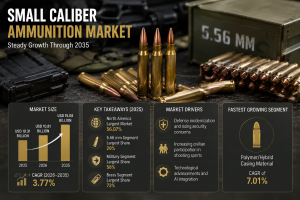
The global small caliber ammunition market is witnessing steady growth as governments continue to strengthen defense capabilities, law enforcement agencies modernize equipment, and civilian firearm ownership remains strong in several regions. The market is projected to grow from USD 10.81 billion in 2026 to approximately USD 15.08 billion by 2035, registering a CAGR of 3.77% during the forecast period. The market was valued at USD 10.31 billion in 2025.
Small caliber ammunition plays a crucial role in military operations, law enforcement activities, hunting, recreational shooting, and personal defense. As geopolitical tensions persist and nations invest in defense modernization programs, demand for reliable and high-performance ammunition continues to increase globally. Furthermore, advancements in ammunition technology, growing shooting sports participation, and rising security concerns are contributing to sustained market expansion.
Small Caliber Ammunition Market Scope
| Market Scope | Details |
|---|---|
| Market Size in 2025 | USD 10.31 Billion |
| Market Size in 2026 | USD 10.81 Billion |
| Market Size by 2035 | USD 15.08 Billion |
| CAGR (2026-2035) | 3.77% |
| Largest Market | North America |
| Segments Covered | By Size, By End-Use Application, By Casing Material, and By Region |
Understanding the Small Caliber Ammunition Market
- Small caliber ammunition refers to cartridges used in firearms with bore diameters generally below .50 caliber. These ammunition products are commonly utilized in rifles, pistols, carbines, and machine guns by military personnel, police forces, security agencies, sports shooters, hunters, and civilian firearm owners.
- The market encompasses the manufacturing, distribution, and supply of ammunition across various calibers, casing materials, and end-use applications. Demand patterns are strongly influenced by defense procurement programs, military conflicts, law enforcement requirements, firearm ownership regulations, and sporting activities.
- The industry remains highly dynamic due to changing geopolitical environments, evolving defense strategies, and continuous technological innovation aimed at improving ammunition performance, safety, and environmental sustainability.
Market Growth Driven by Defense Modernization Programs
- One of the primary factors supporting market growth is the increasing focus on military modernization across major economies. Governments are allocating larger budgets toward upgrading infantry weapons systems and ammunition inventories to enhance combat effectiveness and operational readiness.
- Modern military forces require advanced ammunition capable of delivering superior accuracy, reliability, and terminal performance in diverse battlefield conditions. As armed forces replace aging stockpiles and procure next-generation weapon systems, demand for compatible small caliber ammunition continues to rise.
- Several countries in North America, Europe, Asia-Pacific, and the Middle East are actively investing in defense modernization initiatives, creating long-term opportunities for ammunition manufacturers worldwide.
Rising Civilian Demand Supports Market Expansion
- Civilian firearm ownership remains a significant contributor to the small caliber ammunition market. Growing concerns regarding personal safety, self-defense, and home protection have encouraged many consumers to purchase firearms and related ammunition products.
- Additionally, recreational shooting, target practice, hunting, and competitive shooting sports continue to gain popularity in numerous countries. Shooting ranges, sporting competitions, and firearm training programs are generating consistent demand for small caliber ammunition across civilian markets.
- Manufacturers are responding by introducing ammunition variants specifically designed for personal defense, target shooting, hunting applications, and competitive sports, helping diversify product offerings and expand consumer adoption.
Role of Artificial Intelligence in the Small Caliber Ammunition Industry
- Artificial intelligence is becoming increasingly important throughout the ammunition value chain. Advanced AI technologies are being integrated into design, manufacturing, logistics, inventory management, testing, and training processes.
- AI-powered simulation tools enable manufacturers to optimize ammunition performance before physical production begins. Predictive analytics help identify potential manufacturing defects, improve quality control procedures, and reduce production waste. Automated inspection systems enhance consistency while minimizing human error during manufacturing operations.
- In military applications, AI supports trajectory modeling, battlefield simulations, and ammunition logistics management. Intelligent inventory systems can predict demand patterns, monitor stock levels, and improve supply chain efficiency. AI-driven training platforms also allow military personnel and law enforcement agencies to conduct realistic combat simulations and weapons training exercises.
- As artificial intelligence adoption expands across defense manufacturing ecosystems, ammunition producers are expected to achieve higher operational efficiency, improved product reliability, and reduced production costs.
Also Read More: Video Streaming Market
Growing Demand for Advanced Ammunition Technologies
- Technological advancements continue to reshape the small caliber ammunition landscape. Manufacturers are focusing on improving ballistic performance, accuracy, penetration capabilities, and operational reliability.
- Innovations in projectile design, propellant formulations, casing materials, and manufacturing techniques are helping create next-generation ammunition solutions capable of meeting evolving military and law enforcement requirements.
- The development of lightweight ammunition is another emerging trend. Reducing cartridge weight enables soldiers to carry more rounds without increasing physical burden, improving mobility and mission effectiveness. This trend is encouraging investment in alternative casing materials such as polymer and hybrid designs.
Sustainability Initiatives Are Influencing Product Development
- Environmental concerns are becoming increasingly important within the ammunition industry. Traditional ammunition often contains lead and other materials that can create environmental challenges, particularly in training facilities and shooting ranges.
- Manufacturers are therefore investing in lead-free projectiles, non-toxic primers, and environmentally responsible production methods. Sustainable ammunition solutions are gaining traction among military organizations, law enforcement agencies, and civilian consumers seeking environmentally conscious alternatives.
- The shift toward green ammunition is expected to accelerate over the coming years as environmental regulations become more stringent and sustainability goals gain greater prominence across defense and sporting sectors.
Regional Market Insights
- North America dominated the global small caliber ammunition market in 2025, accounting for 56.07% of total revenue. The region benefits from substantial defense spending, strong military procurement activities, widespread civilian firearm ownership, and a well-established shooting sports culture.
- The United States remains the largest contributor to regional demand due to ongoing military modernization programs, active law enforcement procurement, and a large civilian firearms market.
- Europe continues to witness steady growth supported by increasing defense budgets, NATO modernization initiatives, and heightened regional security concerns.
- Asia-Pacific is expected to emerge as one of the fastest-growing markets during the forecast period. Rising geopolitical tensions, expanding military capabilities, and growing defense investments in countries such as China, India, South Korea, and Japan are creating significant opportunities for ammunition manufacturers.
- Meanwhile, Latin America and the Middle East & Africa are also experiencing increased demand driven by military modernization efforts, internal security requirements, and expanding law enforcement activities.
Segment Analysis
- The 5.56 mm ammunition segment held the largest market share of 29% in 2025. This caliber is widely used by military organizations worldwide due to its balance of accuracy, range, and operational effectiveness.
- The military application segment accounted for 58% of total market revenue in 2025. Continuous defense procurement programs, military readiness initiatives, and evolving battlefield requirements continue to support strong demand from armed forces globally.
- Based on casing material, brass ammunition dominated the market with a 73% share in 2025. Brass remains the preferred material due to its durability, reliability, corrosion resistance, and proven performance characteristics.
- The polymer and hybrid casing segment is expected to register the fastest growth during the forecast period, expanding at a CAGR of 7.01%. These advanced materials offer significant weight reduction benefits while maintaining performance standards, making them increasingly attractive for military and commercial applications.
Competitive Landscape
- The small caliber ammunition market remains highly competitive, with leading defense contractors and ammunition manufacturers investing heavily in product innovation, production capacity expansion, and research and development activities.
- Companies are focusing on enhancing ammunition performance, improving sustainability, reducing manufacturing costs, and securing long-term defense contracts. Strategic partnerships with military organizations and law enforcement agencies are also helping manufacturers strengthen their market positions.
- Major industry participants continue to invest in advanced manufacturing technologies, automation systems, and next-generation ammunition development programs to meet evolving customer requirements.
Future Outlook
- The future of the small caliber ammunition market appears positive as defense modernization programs, rising security concerns, and growing civilian participation in shooting sports continue to support demand worldwide. Advances in artificial intelligence, smart manufacturing, lightweight materials, and environmentally sustainable ammunition technologies are expected to transform the industry over the next decade.
- As governments increase defense expenditures and military organizations seek higher-performance ammunition solutions, manufacturers that prioritize innovation, operational efficiency, and sustainability will be best positioned to capitalize on emerging opportunities. With steady growth projected through 2035, the small caliber ammunition market is expected to remain an essential component of the global defense and firearms ecosystem.
Get this report to explore global market size, share, CAGR, and trends, featuring detailed segmental analysis and an insightful competitive landscape overview: https://www.precedenceresearch.com/sample/3321
You can place an order or ask any questions. Please feel free to contact us at sales@precedenceresearch.com |+1 804 441 9344

- Europe L7 Electric Micro Cars Market Size: Transforming Urban Mobility Through Sustainable Transportation - June 19, 2026
- Digestive Health Products Market Size: The Rising Importance of Gut Wellness in Global Healthcare - June 18, 2026
- Small Caliber Ammunition Market Size to Reach USD 15.08 Billion by 2035 - June 17, 2026