
The global collaborative whiteboard software market is witnessing rapid expansion as businesses, educational institutions, and remote teams increasingly adopt digital collaboration platforms. The growing popularity of hybrid work models, virtual classrooms, and cloud-based communication tools is significantly driving demand for interactive whiteboard software worldwide.
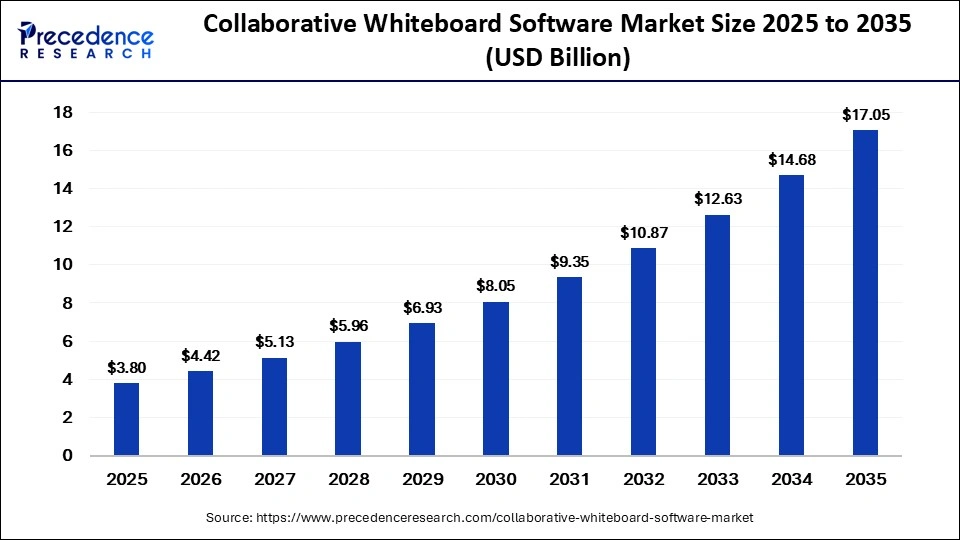
Collaborative whiteboard platforms allow teams to brainstorm ideas, manage workflows, conduct virtual meetings, and collaborate in real time regardless of geographic location. These solutions have become essential for enterprises seeking enhanced productivity, seamless communication, and efficient remote collaboration.
According to industry estimates, the global collaborative whiteboard software market size was valued at USD 2.12 billion in 2025 and is projected to grow from USD 2.45 billion in 2026 to approximately USD 9.84 billion by 2035, expanding at a CAGR of 16.70% during the forecast period.
Read Also: Digital Rights Management Market
Market Overview
Collaborative whiteboard software refers to digital platforms that enable multiple users to interact, draw, annotate, share ideas, and collaborate on a virtual whiteboard simultaneously. These solutions are commonly integrated with video conferencing, project management, and enterprise communication systems.
The increasing demand for real-time collaboration tools across industries such as education, IT, healthcare, BFSI, media, and corporate enterprises is accelerating market growth. Organizations are increasingly relying on digital workspaces to improve workflow efficiency and employee engagement.
The widespread adoption of remote work culture after the COVID-19 pandemic has permanently transformed workplace collaboration strategies, boosting long-term demand for cloud-based whiteboarding platforms.
Key Market Drivers
Rapid Growth of Hybrid and Remote Work Models
One of the primary factors driving the collaborative whiteboard software market is the global shift toward hybrid and remote work environments.
Businesses are increasingly adopting digital collaboration tools to support geographically distributed teams and maintain operational efficiency. Collaborative whiteboard platforms allow employees to brainstorm, plan projects, conduct workshops, and share visual ideas in real time.
Companies are integrating whiteboard solutions into enterprise ecosystems alongside platforms such as Microsoft Teams, Zoom, Slack, and Google Workspace to streamline communication and improve productivity.
Increasing Adoption in Education Sector
The education sector has emerged as a major user of collaborative whiteboard software due to the growing popularity of online learning and virtual classrooms.
Educational institutions are implementing digital whiteboard platforms to create interactive learning environments, improve student engagement, and facilitate remote instruction.
The rise of e-learning platforms and digital education initiatives worldwide is expected to further accelerate adoption during the forecast period.
Growing Demand for Visual Collaboration Tools
Modern enterprises increasingly recognize the importance of visual collaboration in improving innovation and decision-making processes.
Collaborative whiteboard software enables teams to create mind maps, diagrams, flowcharts, and project plans in real time, improving team coordination and creativity.
Artificial Intelligence Integration Transforming the Market
Artificial intelligence is becoming a transformative force in the collaborative whiteboard software industry.
AI-powered features such as smart content suggestions, automated diagram generation, handwriting recognition, workflow automation, and meeting summarization are enhancing user experience and productivity.
Advanced AI tools can automatically organize brainstorming sessions, generate templates, and convert handwritten notes into editable digital content.
The integration of generative AI into collaborative platforms is expected to significantly reshape digital workplace collaboration over the coming years.
Emerging Market Trends
Increasing Integration with Video Conferencing Platforms
Collaborative whiteboard vendors are increasingly integrating their solutions with popular video conferencing applications such as Microsoft Teams, Zoom, and Google Meet.
This integration allows users to conduct interactive virtual meetings, brainstorming sessions, and presentations within a unified digital workspace.
Expansion of Cloud-Based Deployment Models
Cloud deployment models dominate the collaborative whiteboard software market due to their scalability, remote accessibility, lower infrastructure costs, and simplified maintenance.
Cloud-based solutions allow organizations to support distributed teams efficiently while enabling real-time synchronization across devices.
Growing Adoption of Touchscreen and Interactive Displays
The increasing use of touchscreen displays, interactive smart boards, and digital meeting rooms in enterprises and educational institutions is boosting demand for collaborative whiteboard software.
Organizations are investing in smart collaboration environments to improve workplace efficiency and hybrid meeting experiences.
Market Restraints
Data Privacy and Security Concerns
Despite strong growth prospects, concerns regarding cybersecurity, unauthorized access, and data privacy remain major challenges for the market.
Organizations handling sensitive business information often require advanced encryption, secure access management, and compliance with data protection regulations.
High Subscription and Integration Costs
Advanced enterprise-grade whiteboard platforms can involve significant subscription and integration expenses, especially for small and medium-sized businesses.
Integration with existing enterprise systems and employee training requirements may also increase operational costs.
Segment Analysis
By Deployment
Cloud Segment Dominates the Market
The cloud segment accounted for the largest market share in 2025 due to increasing demand for scalable, remotely accessible collaboration solutions. Cloud-based platforms offer seamless updates, multi-device compatibility, and reduced IT infrastructure requirements.
On-Premises Segment Maintains Presence
Large enterprises and government organizations continue to adopt on-premises deployment models to maintain stricter control over sensitive data and internal collaboration systems.
By End User
Enterprises Hold the Largest Market Share
Large enterprises represent the dominant end-user segment due to widespread adoption of digital collaboration platforms for project management, brainstorming, training, and innovation workshops.
Organizations are increasingly prioritizing collaborative technologies to improve employee productivity and communication efficiency.
Education Sector Witnessing Rapid Growth
The education segment is expected to grow at a significant CAGR during the forecast period owing to increasing digital learning adoption and rising investments in virtual classroom technologies.
Regional Analysis
North America
North America dominated the global collaborative whiteboard software market in 2025 due to advanced digital infrastructure, high adoption of remote work technologies, and the strong presence of leading software providers.
The United States remains the largest contributor owing to widespread enterprise digitization and rapid adoption of cloud collaboration tools.
Europe
Europe is witnessing substantial market growth due to increasing hybrid work adoption, digital education initiatives, and rising investments in enterprise collaboration technologies.
Countries such as Germany, the United Kingdom, and France are actively implementing advanced workplace collaboration platforms across industries.
Asia Pacific
Asia Pacific is expected to register the fastest CAGR during the forecast period due to expanding digital transformation initiatives, growing startup ecosystems, and increasing adoption of cloud-based collaboration tools.
Countries such as India, China, Japan, and South Korea are emerging as high-growth markets driven by rapid enterprise digitization and online education expansion.
Competitive Landscape
The collaborative whiteboard software market is highly competitive, with leading technology companies focusing on AI integration, cloud innovation, strategic partnerships, and platform interoperability.
Major Companies Operating in the Market
Key players in the collaborative whiteboard software market include:
- Microsoft
- Zoom
- Miro
- MURAL
- Cisco
- Lucidspark
- Conceptboard
Recent Developments
- Collaborative software vendors are increasingly integrating generative AI features into digital whiteboard platforms to improve workflow automation and brainstorming efficiency.
- Enterprise collaboration providers are focusing on expanding integration capabilities with video conferencing and project management ecosystems.
- The rising demand for hybrid workplace solutions continues to encourage innovation in real-time digital collaboration technologies.
Get a Sample Copy: https://www.precedenceresearch.com/sample/8402
For inquiries regarding discounts, bulk purchases, or customization requests, please contact us at sales@precedenceresearch.com