
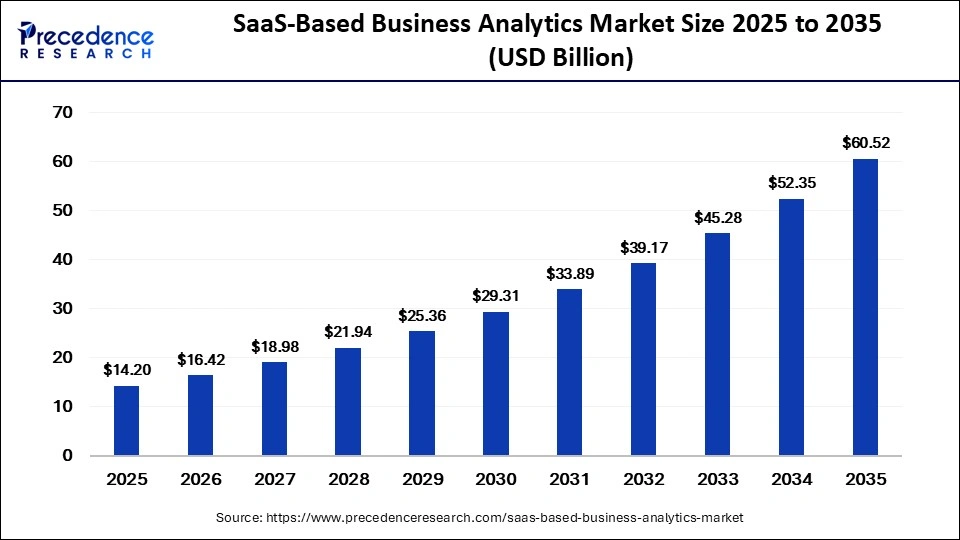
The global SaaS-based business analytics market is projected to reach USD 60.52 billion by 2035, driven by AI-powered analytics, cloud adoption, predictive insights, and digital transformation initiatives across industries worldwide.
Read Also: Data Loss Prevention Advanced Technologies Market
SaaS-Based Business Analytics Market Overview
The global SaaS-based business analytics market is witnessing remarkable growth as organizations increasingly prioritize data-driven decision-making and cloud-based operational strategies. Businesses across industries are rapidly adopting Software-as-a-Service (SaaS) analytics platforms to improve scalability, reduce infrastructure costs, and gain real-time insights from massive volumes of enterprise data.
According to Precedence Research, the global SaaS-based business analytics market size was valued at USD 14.20 billion in 2025 and is projected to grow from USD 16.42 billion in 2026 to approximately USD 60.52 billion by 2035, expanding at a CAGR of 15.60% during the forecast period. The market growth is primarily driven by increasing demand for AI-powered analytics, real-time business intelligence, predictive modeling, and cloud-native enterprise applications.
SaaS-based business analytics platforms help enterprises collect, process, visualize, and interpret complex business data without maintaining expensive on-premise IT infrastructure. These platforms provide scalable, subscription-based analytics capabilities that support strategic decision-making, operational efficiency, customer engagement, and financial forecasting.
The growing adoption of Industry 4.0 technologies, artificial intelligence (AI), machine learning (ML), Internet of Things (IoT), and digital transformation initiatives is further accelerating the expansion of the SaaS-based business analytics market worldwide.
Introduction
In today’s digital economy, businesses generate enormous amounts of data from customer interactions, enterprise applications, IoT devices, financial systems, and supply chain operations. Managing and analyzing this data effectively has become critical for maintaining competitiveness and operational agility.
Traditional analytics systems often struggle with scalability, flexibility, and real-time processing requirements. As a result, organizations are increasingly transitioning toward SaaS-based business analytics platforms that offer cloud-native infrastructure, AI-powered automation, and real-time data accessibility.
These modern analytics platforms enable enterprises to transform raw data into actionable insights while minimizing deployment costs and reducing IT complexity. Companies are now leveraging SaaS analytics to improve customer experiences, optimize supply chains, automate reporting, and enhance overall business performance.
The rapid shift toward hybrid work environments and digital-first business models has further strengthened the demand for cloud-based analytics solutions across industries such as BFSI, healthcare, manufacturing, retail, telecommunications, and government sectors.
What is SaaS-Based Business Analytics?
SaaS-based business analytics refers to cloud-delivered analytics software that enables organizations to access data visualization, predictive analytics, reporting tools, and business intelligence applications through subscription-based models.
Unlike traditional on-premise analytics systems, SaaS analytics platforms eliminate the need for expensive hardware infrastructure and complex software maintenance. Businesses can access advanced analytics tools through web browsers and cloud platforms while benefiting from scalability, remote accessibility, automatic updates, and lower operational costs.
These platforms support various analytics functions, including:
- Descriptive analytics
- Predictive analytics
- Prescriptive analytics
- Customer analytics
- Financial analytics
- Sales and marketing analytics
- HR analytics
- Supply chain analytics
Modern SaaS analytics solutions increasingly integrate AI and machine learning capabilities to automate insights generation and improve business forecasting accuracy.
Key Market Drivers
Growing Demand for Real-Time Data Insights
Organizations today require real-time visibility into business operations to respond quickly to changing market conditions and customer demands. SaaS-based analytics platforms enable enterprises to access instant dashboards, reports, and predictive insights from any location.
Real-time analytics is becoming especially important in industries such as e-commerce, manufacturing, finance, and logistics, where rapid decision-making directly impacts profitability and customer satisfaction.
According to recent market analysis, the growing need for real-time business intelligence is one of the strongest factors driving market expansion globally.
Rapid Adoption of Artificial Intelligence and Machine Learning
AI and machine learning technologies are transforming the business analytics landscape by enabling intelligent automation, anomaly detection, forecasting, and predictive modeling.
AI-powered SaaS analytics platforms can analyze massive datasets, identify hidden patterns, and generate actionable insights with minimal human intervention. Businesses are increasingly leveraging these technologies to improve operational efficiency and customer engagement.
The integration of generative AI and conversational analytics is also simplifying analytics accessibility for non-technical business users.
Increasing Shift Toward Cloud Infrastructure
The widespread migration toward cloud computing is significantly boosting the adoption of SaaS-based analytics solutions. Cloud platforms offer scalability, flexibility, remote accessibility, and cost efficiency compared to traditional on-premise infrastructure.
Businesses are increasingly adopting cloud-first strategies to support hybrid work environments and digitally connected enterprise ecosystems.
Rising Focus on Cost Efficiency
SaaS platforms follow subscription-based pricing models, allowing organizations to reduce upfront infrastructure investments and IT maintenance costs. This affordability makes advanced analytics accessible to small and medium-sized enterprises (SMEs) as well as large corporations.
Market Restraints
Complex Integration with Legacy Systems
One of the major challenges in the SaaS-based business analytics market is integrating modern cloud platforms with existing legacy enterprise systems such as outdated ERP and CRM infrastructure.
Many organizations continue to rely on traditional IT systems that may not easily connect with cloud-native analytics solutions. This integration complexity increases deployment costs and implementation timelines.
Data Privacy and Security Concerns
As businesses increasingly migrate sensitive operational and customer data to cloud environments, concerns regarding cybersecurity, regulatory compliance, and data privacy remain significant.
Industries such as healthcare, BFSI, and government sectors often face strict compliance requirements related to data storage and management.
Shortage of Skilled Analytics Professionals
Despite automation advancements, organizations still require skilled professionals capable of managing analytics ecosystems, interpreting insights, and optimizing AI models. The shortage of qualified analytics talent may limit adoption in some regions.
Emerging Opportunities in the Market
Vertical-Specific Analytics Solutions
The demand for industry-specific SaaS analytics platforms is growing rapidly. Organizations are increasingly seeking customized analytics solutions tailored to the unique requirements of healthcare, retail, finance, manufacturing, and telecommunications sectors.
Specialized analytics platforms can support fraud detection, patient management, customer behavior analysis, predictive maintenance, and compliance management more effectively.
Expansion Across Emerging Economies
Emerging economies in Asia-Pacific, Latin America, and the Middle East are experiencing rapid digital transformation and cloud adoption. Increasing internet penetration, government digitization initiatives, and growing SME sectors are creating substantial growth opportunities for SaaS analytics vendors.
Growth of Embedded Analytics
Embedded analytics is becoming a major trend as businesses integrate analytics capabilities directly into enterprise applications such as ERP, CRM, and HR management systems.
This integration allows users to access analytics insights within operational workflows, improving productivity and decision-making efficiency.
SaaS-Based Business Analytics Market Trends
AI-Powered Analytics Integration
SaaS analytics vendors are increasingly integrating AI and machine learning technologies to automate reporting, predictive modeling, and intelligent recommendations. AI-powered analytics is becoming a major differentiator in the competitive landscape.
Growth of Predictive Analytics
Predictive analytics solutions are witnessing rapid adoption due to their ability to forecast market trends, customer behavior, and operational risks.
The predictive analytics segment is expected to grow significantly during the forecast period as organizations increasingly prioritize proactive decision-making.
User-Friendly Analytics Platforms
Modern SaaS analytics platforms are focusing on intuitive user interfaces and self-service analytics capabilities that allow non-technical employees to generate reports and insights independently.
Rise of Real-Time Streaming Analytics
Businesses are increasingly adopting real-time streaming analytics technologies to process live data streams from IoT devices, customer interactions, and enterprise systems.
Segment Analysis
By Component
Software Segment Dominated the Market
The software segment accounted for the largest market share of approximately 85% in 2025 due to increasing adoption of AI-powered analytics platforms and cloud-native business intelligence solutions.
Services Segment
The services segment is expected to grow steadily due to rising demand for consulting, implementation, integration, training, and managed analytics services.
By Deployment Model
Public Cloud Segment Led the Market
The public cloud segment dominated the market with a 65% share in 2025 due to its affordability, scalability, and ease of deployment.
Hybrid Cloud Segment
Hybrid cloud deployment is expected to witness strong growth as enterprises seek balanced solutions that combine data security with cloud scalability.
By Analytics Type
Descriptive Analytics Dominated
Descriptive analytics accounted for the largest market share in 2025 as organizations continue to rely heavily on historical data analysis and performance reporting.
Predictive Analytics Expected to Grow Rapidly
Predictive analytics is projected to witness the fastest growth due to increasing adoption of AI-driven forecasting and predictive modeling solutions.
Regional Analysis
North America
North America dominated the global SaaS-based business analytics market with a 45% share in 2025. The region benefits from advanced digital infrastructure, high cloud adoption rates, and strong presence of major technology providers such as Microsoft, Oracle, IBM, Salesforce, and Google Cloud.
The United States remains the primary contributor due to extensive enterprise digital transformation initiatives and increasing investments in AI-driven analytics platforms.
Asia Pacific
Asia Pacific is expected to grow at the fastest CAGR of 21.5% during the forecast period. Rapid industrial digitalization, expanding SME sectors, increasing cloud adoption, and government initiatives supporting digital transformation are driving regional growth.
Countries such as China, India, Japan, and South Korea are becoming major growth hubs for cloud analytics technologies.
Europe
Europe is witnessing strong growth due to Industry 4.0 adoption, strict data governance frameworks, and increasing investments in AI-powered enterprise analytics.
Competitive Landscape
The SaaS-based business analytics market is highly competitive, with companies focusing on AI integration, cloud-native innovation, strategic partnerships, and advanced data visualization technologies.
Key Companies in the Market
- Microsoft
- Oracle
- SAP
- IBM
- Salesforce
- Google Cloud
- Amazon Web Services
- Tableau
- Qlik
- SAS
- MicroStrategy
- ThoughtSpot
Get Sample Copy: https://www.precedenceresearch.com/sample/8398
For inquiries regarding discounts, bulk purchases, or customization requests, please contact us at sales@precedenceresearch.com
