
The global AI in regulatory technology market is witnessing remarkable expansion as organizations across banking, healthcare, insurance, government, and e-commerce sectors increasingly adopt artificial intelligence-powered compliance solutions. According to Precedence Research, the market is expected to grow from USD 22.72 billion in 2026 to approximately USD 144.26 billion by 2035, registering a strong CAGR of 22.80% during the forecast period.
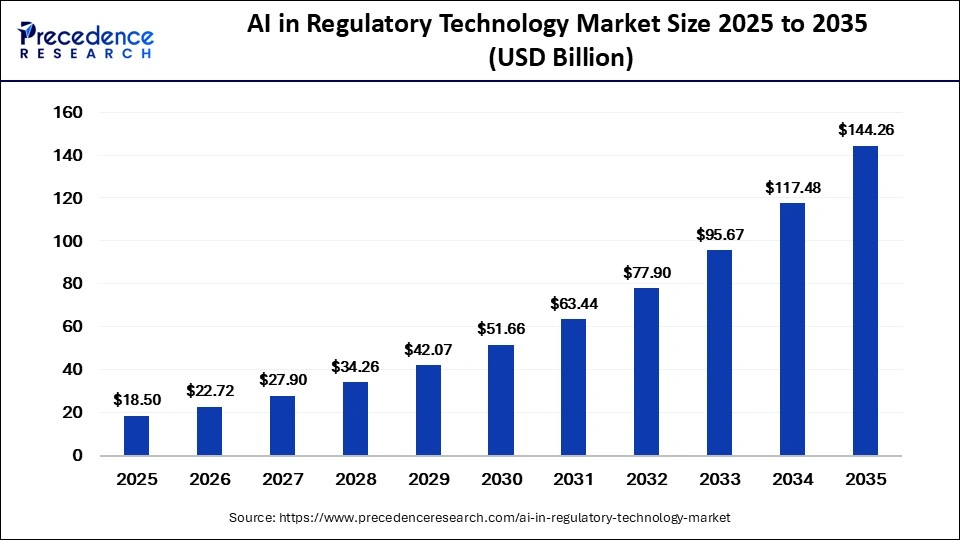
The rapid rise in global regulatory complexity, increasing financial fraud risks, growing cybersecurity threats, and the expanding use of digital financial systems are creating significant demand for AI-driven regulatory technologies. Businesses are increasingly turning to machine learning, natural language processing, robotic process automation, and predictive analytics to automate compliance management and reduce operational costs.
Read Also: Computational Medicine and Drug Discovery Software Market
Why Is AI Becoming Critical in Regulatory Technology?
Regulatory compliance has become increasingly challenging for organizations operating across multiple jurisdictions. Traditional manual compliance systems often struggle to manage rapidly changing regulations, increasing documentation requirements, and large volumes of transactional data.
AI-powered regulatory technology solutions are helping organizations automate repetitive compliance processes, improve risk detection, monitor transactions in real time, and reduce human errors in reporting. These technologies are enabling enterprises to shift from reactive compliance management to proactive risk mitigation strategies.
The growing adoption of AI in regulatory operations is particularly evident in industries such as banking, financial services, healthcare, and insurance, where regulatory scrutiny continues to intensify globally.
How Is Machine Learning Transforming the RegTech Industry?
Machine learning has emerged as one of the most influential technologies in the AI in regulatory technology market. The machine learning segment accounted for 35% of the market share in 2025 due to its ability to automate anti-money laundering operations, fraud detection, transaction monitoring, and risk analysis.
AI systems powered by machine learning can continuously analyze transaction patterns, customer behavior, and historical compliance data to identify suspicious activities with higher accuracy. These systems help organizations reduce false positives while improving the speed and efficiency of investigations.
Predictive analytics solutions are also becoming increasingly important as companies seek to identify potential compliance risks before they escalate into regulatory violations.
Why Is Natural Language Processing Gaining Strong Momentum?
Natural language processing (NLP) is rapidly becoming a key technology within regulatory technology platforms. The NLP segment captured 25% of the market share in 2025 and is projected to witness the fastest growth during the forecast period.
NLP technologies help organizations analyze vast amounts of unstructured regulatory documents, legal frameworks, compliance reports, and policy updates. These tools enable businesses to extract actionable insights from complex regulatory content and automate regulatory reporting workflows.
As global regulations continue evolving rapidly, NLP-powered compliance platforms are helping organizations remain compliant while significantly reducing manual workloads.
How Is Cloud Deployment Accelerating Market Expansion?
Cloud-based deployment models dominated the market with a 70% share in 2025 due to their scalability, cost-effectiveness, and real-time analytics capabilities.
Cloud infrastructure allows enterprises to process large volumes of regulatory data more efficiently while enabling faster implementation of AI-powered compliance tools. Cloud platforms also improve collaboration among compliance teams, auditors, and regulatory authorities.
The increasing adoption of hybrid cloud environments is further supporting the deployment of advanced AI governance systems across multinational enterprises.
Why Is BFSI the Largest End-Use Industry?
The banking, financial services, and insurance (BFSI) sector accounted for 55% of the total market share in 2025, making it the dominant end-use industry.
Financial institutions face constant pressure to comply with anti-money laundering regulations, Know Your Customer (KYC) requirements, fraud prevention rules, and evolving data privacy regulations. AI-powered regulatory platforms help banks automate compliance workflows, improve audit readiness, and detect suspicious transactions in real time.
The increasing sophistication of cybercrime and digital fraud is further driving the demand for intelligent compliance monitoring systems within the BFSI sector.
How Are Governments Supporting AI Regulatory Adoption?
Governments worldwide are increasingly introducing AI governance frameworks and digital compliance initiatives to improve transparency, accountability, and operational efficiency.
The government sector is expected to register the fastest CAGR during the forecast period as public agencies adopt AI-driven compliance tools for risk management, public sector audits, and automated regulatory oversight.
In May 2026, Colorado lawmakers proposed revisions to existing AI laws focused on automated decision-making technologies, highlighting the growing regulatory attention toward responsible AI deployment.
Governments are also encouraging the adoption of AI governance frameworks for ethical AI implementation, cybersecurity compliance, and ESG reporting.
Why Is North America Leading the Global Market?
North America held the largest market share of 40% in 2025 due to strong technological infrastructure, rapid AI adoption, and the presence of major regulatory technology providers.
The United States continues to dominate the regional market as financial institutions, healthcare providers, and government agencies increase investments in AI-powered compliance systems. Regulatory pressure surrounding cybersecurity, financial transparency, and consumer protection is accelerating the adoption of advanced RegTech solutions.
Major companies operating in the market include IBM, Microsoft, Oracle, Thomson Reuters, NICE Ltd., SAS Institute, Fiserv, and Feedzai.
Why Is Asia Pacific Emerging as the Fastest-Growing Region?
Asia Pacific is projected to witness the fastest growth during the forecast period due to rapid digital transformation, rising fintech adoption, and expanding government initiatives supporting AI innovation.
Countries such as India, China, Japan, and Singapore are investing heavily in AI-driven financial infrastructure, cybersecurity systems, and digital governance frameworks. The increasing adoption of digital banking services and online transactions is creating strong demand for intelligent fraud prevention and compliance monitoring solutions.
The expansion of fintech startups and growing awareness regarding regulatory automation are also supporting regional market growth.
How Is AI Governance Shaping the Future of Regulatory Technology?
AI governance is emerging as one of the most important trends within the regulatory technology landscape. Organizations are increasingly focusing on explainability, bias detection, auditability, and ethical AI implementation.
Academic research highlights that AI regulation must balance innovation with accountability and transparency. Emerging governance frameworks aim to create more structured oversight mechanisms for AI-driven systems operating in sensitive sectors such as finance and healthcare.
Industry experts also emphasize the growing importance of integrating compliance requirements into AI system design from the early stages of development.
What Challenges Could Limit Market Growth?
Despite strong growth opportunities, the market faces several challenges including fragmented global regulations, legacy infrastructure integration issues, and concerns surrounding AI transparency.
Organizations operating across multiple regions often struggle to manage varying regulatory standards and compliance requirements. Integrating modern AI platforms with legacy banking and enterprise systems can also be expensive and technically complex.
In addition, concerns regarding data privacy, algorithmic bias, and AI explainability continue to raise regulatory and ethical questions for enterprises deploying AI-powered compliance systems.
What Does the Future Hold for the AI in Regulatory Technology Market?
The future of the AI in regulatory technology market will likely be shaped by continued advancements in generative AI, predictive analytics, automated governance systems, and real-time risk monitoring.
As organizations face increasing pressure to improve compliance efficiency while managing rising regulatory complexity, AI-powered RegTech platforms are expected to become central to enterprise risk management strategies.
The convergence of AI, cloud computing, and regulatory automation will continue transforming how organizations manage compliance, detect fraud, monitor transactions, and maintain trust in increasingly digital economies.
Get Sample Copy: https://www.precedenceresearch.com/sample/8387
For inquiries regarding discounts, bulk purchases, or customization requests, please contact us at sales@precedenceresearch.com
