
The global computational medicine and drug discovery software market is entering a transformative phase as pharmaceutical companies, biotechnology firms, and research institutions increasingly adopt artificial intelligence-driven platforms to accelerate drug discovery and improve clinical outcomes. According to Precedence Research, the market is projected to grow from USD 12.94 billion in 2026 to approximately USD 60.52 billion by 2035, expanding at a CAGR of 18.70% during the forecast period.
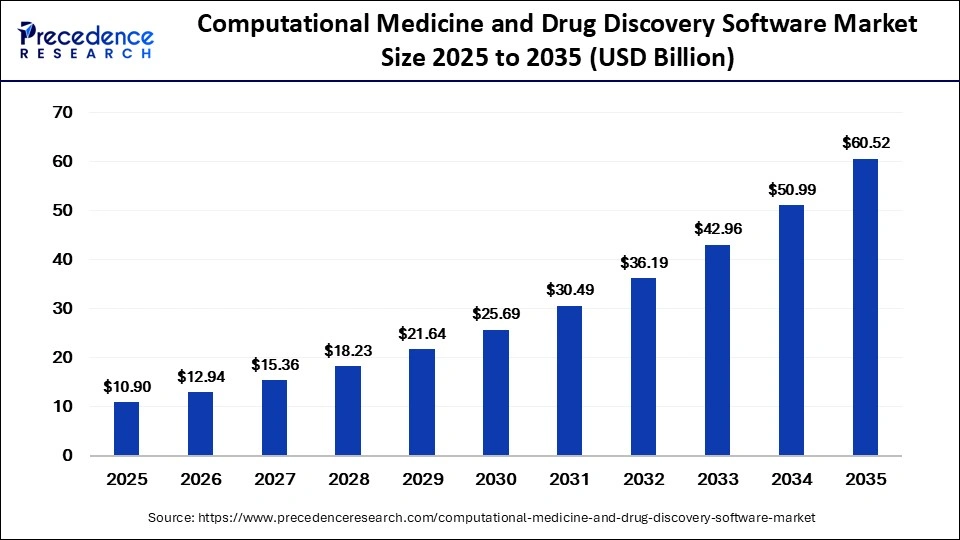
The growing pressure to reduce drug development timelines, rising R&D expenditures, and increasing demand for precision medicine are driving the rapid adoption of computational technologies across the healthcare ecosystem. Modern software solutions powered by AI, machine learning, cloud computing, and high-performance computing are enabling researchers to identify drug targets faster, optimize clinical trials, and improve therapeutic success rates.
Read Also: Data Center Robotics Market
Why Is Computational Medicine Becoming Essential in Drug Discovery?
Traditional drug development is often expensive, time-consuming, and prone to failure during late-stage clinical trials. Computational medicine software addresses these challenges by enabling virtual simulations, predictive analytics, and automated molecular modeling. These tools help researchers evaluate drug candidates before physical testing begins, reducing both cost and risk.
The increasing complexity of chronic diseases, rare disorders, and personalized therapies is also encouraging pharmaceutical companies to rely on computational approaches. AI-driven systems can analyze massive biological datasets, identify molecular interactions, and predict treatment responses with higher accuracy than traditional research methods.
Furthermore, the integration of genomic data, real-world evidence, and digital biomarkers into drug discovery workflows is transforming how pharmaceutical innovation is conducted globally.
How Is Artificial Intelligence Transforming Drug Discovery Software?
Artificial intelligence has emerged as the core technological driver of the computational medicine and drug discovery software market. The AI and machine learning segment accounted for 35% of the market share in 2025 due to its ability to accelerate molecule design, improve predictive modeling, and automate research workflows.
AI-powered platforms are significantly reducing the time required to identify promising compounds and optimize lead candidates. Generative AI tools are also helping researchers create novel molecular structures and improve the efficiency of drug screening processes.
Recent industry developments highlight the growing importance of AI in pharmaceutical research. Amazon Web Services introduced “Amazon Bio Discovery,” an AI-powered platform designed to help scientists conduct computational workflows without coding expertise. The platform enables researchers to generate and evaluate potential drug molecules faster using specialized biological foundation models.
Similarly, pharmaceutical giant Eli Lilly expanded its collaboration with Insilico Medicine in a deal worth up to USD 2.75 billion to advance AI-powered drug discovery initiatives. The partnership focuses on leveraging advanced AI engines for preclinical drug development and biomarker identification.
What Role Does Cloud Computing Play in Market Expansion?
Cloud-based deployment models are rapidly gaining popularity in computational medicine due to their scalability, flexibility, and cost efficiency. The cloud-based segment dominated the market with a 60% share in 2025 and is expected to witness strong growth throughout the forecast period.
Cloud platforms allow pharmaceutical companies and research institutions to access advanced computational tools and large datasets without investing heavily in infrastructure. They also improve collaboration among geographically dispersed research teams, accelerating innovation and reducing operational complexity.
The growing adoption of hybrid cloud environments is further enhancing data accessibility and computational efficiency in pharmaceutical R&D operations.
Why Are Pharmaceutical and Biotechnology Companies Leading Adoption?
Pharmaceutical and biotechnology companies accounted for the largest market share of 55% in 2025 due to their extensive R&D activities and increasing investment in advanced drug discovery technologies.
These organizations are under constant pressure to develop innovative therapies faster while reducing development costs and improving regulatory success rates. Computational medicine software enables them to optimize lead discovery, identify biomarkers, and simulate biological processes more effectively.
Contract research organizations (CROs) are also emerging as key users of computational drug discovery software as outsourcing trends continue to grow globally. CROs help pharmaceutical companies accelerate research workflows and improve productivity through advanced computational capabilities.
How Are Molecular Modeling and Simulation Tools Driving Innovation?
Molecular modeling and simulation software remains one of the most widely used categories in computational drug discovery. The segment captured 25% of the market share in 2025 due to its critical role in structure-based drug design.
These tools help researchers understand molecular interactions, predict drug behavior, and identify potential toxicity risks during early-stage development. By reducing experimental failures and improving decision-making, molecular modeling platforms contribute significantly to faster and more cost-effective drug development.
In addition, advanced simulation technologies such as digital twins and in silico modeling are gaining traction for their ability to replicate biological systems virtually, enabling researchers to test therapeutic hypotheses more efficiently.
Why Is North America Dominating the Market?
North America held the largest share of the computational medicine and drug discovery software market in 2025, accounting for approximately 45% of total revenue.
The region benefits from strong pharmaceutical infrastructure, extensive AI adoption, significant venture capital investments, and the presence of leading biotech companies and research institutions. The United States, in particular, remains a global leader due to its advanced healthcare ecosystem and favorable regulatory framework.
Major technology providers and pharmaceutical firms in North America are continuously investing in AI-driven drug discovery platforms to strengthen research capabilities and accelerate therapeutic innovation.
Why Is Asia Pacific Emerging as the Fastest-Growing Region?
Asia Pacific is projected to register the fastest CAGR of 22.5% between 2026 and 2035 due to increasing healthcare digitization, expanding pharmaceutical manufacturing, and growing investment in biotechnology research.
Countries such as China, India, Japan, and South Korea are witnessing rapid growth in clinical research activities and bioinformatics adoption. Government initiatives supporting AI innovation and precision medicine are also encouraging regional market expansion.
The availability of skilled data scientists, improving healthcare infrastructure, and rising demand for cost-effective drug development solutions are expected to further accelerate growth across Asia Pacific.
How Are Research Collaborations and Mergers Shaping the Competitive Landscape?
The computational medicine and drug discovery software market is highly dynamic, with companies focusing on partnerships, acquisitions, and AI integration strategies to strengthen their market position.
Industry participants are collaborating with cloud providers, research institutes, and biotech firms to improve drug development efficiency and expand platform capabilities. Companies are also investing heavily in generative AI, real-world data analytics, and precision medicine technologies.
The acquisition of AI drug discovery company Exscientia by Recursion Pharmaceuticals highlighted the growing consolidation trend within the industry, as organizations seek to combine computational expertise with large-scale biological datasets and automation technologies.
What Are the Key Challenges Facing the Market?
Despite strong growth prospects, the market faces several challenges. Data privacy concerns, regulatory complexities, and high implementation costs remain major barriers for some organizations. Integrating diverse biological datasets and ensuring algorithm transparency also continue to be significant challenges for AI-driven systems.
Additionally, the shortage of skilled professionals with expertise in computational biology, AI modeling, and bioinformatics may slow adoption in certain regions.
However, continuous technological advancements, increasing investment in healthcare AI, and growing acceptance of computational methods by regulatory agencies are expected to support long-term market growth.
What Does the Future Hold for Computational Medicine and Drug Discovery Software?
The future of computational medicine is expected to be shaped by advancements in generative AI, quantum computing, multi-omics analysis, and digital twin technologies. These innovations are likely to revolutionize the pharmaceutical industry by enabling faster, more precise, and highly personalized drug development processes.
As healthcare systems continue shifting toward precision medicine and data-driven therapeutics, computational medicine software will play an increasingly central role in disease modeling, biomarker discovery, and clinical trial optimization.
The growing collaboration between technology companies, pharmaceutical firms, and research organizations is expected to create new opportunities for innovation and accelerate the next generation of AI-powered healthcare solutions.
Get Sample Copy: https://www.precedenceresearch.com/sample/8386
For inquiries regarding discounts, bulk purchases, or customization requests, please contact us at sales@precedenceresearch.com