
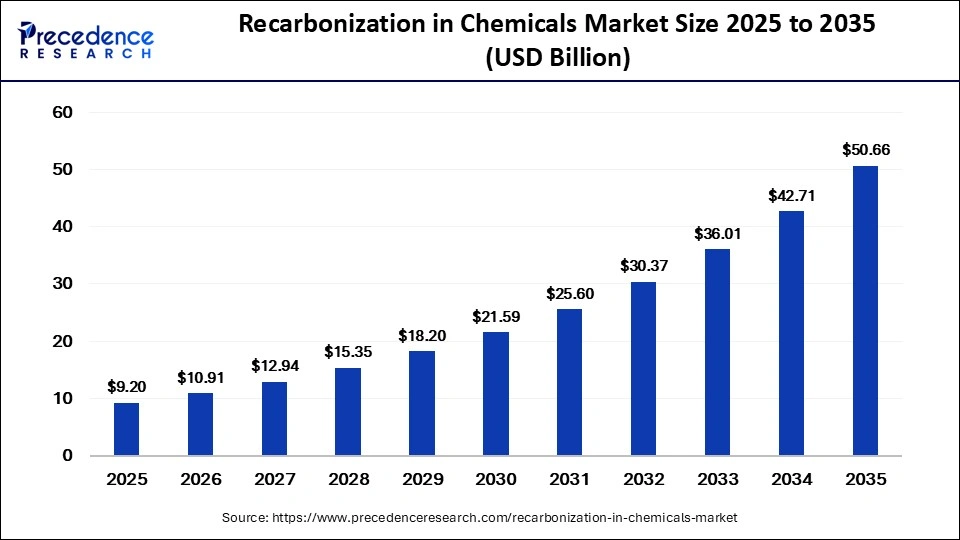
The global recarbonization in chemicals market is projected to reach USD 50.66 billion by 2035, driven by CCUS technologies, green hydrogen adoption, and circular economy initiatives.
Introduction
The global recarbonization in chemicals market is emerging as a transformative force in the chemical industry, enabling companies to convert carbon emissions into valuable resources. As industries intensify efforts toward decarbonization and sustainability, recarbonization technologies are gaining significant traction.
The market is projected to grow from USD 10.91 billion in 2026 to approximately USD 50.66 billion by 2035, expanding at a robust CAGR of 18.60%.
This rapid growth is driven by increasing environmental regulations, rising demand for sustainable chemical production, and significant investments in carbon capture, utilization, and storage (CCUS) technologies.
Read Also: Competitive Intelligence Tools Market
What is Recarbonization in Chemicals?
Recarbonization in chemicals refers to the process of capturing carbon dioxide (CO₂) emissions and converting them into useful chemical products. Instead of treating CO₂ as waste, industries are using it as a feedstock to produce fuels, polymers, fertilizers, and construction materials.
Key technologies involved include:
- Carbon Capture and Utilization (CCU)
- Carbon Capture and Storage (CCS)
- Direct Air Capture (DAC)
- Carbon mineralization
This approach supports circular economy principles and helps reduce industrial carbon footprints.
Key Market Insights
The market was valued at USD 9.20 billion in 2025 and is expected to reach USD 50.66 billion by 2035.
Europe dominated the market with a 35% share in 2025, while Asia Pacific is projected to grow at the fastest CAGR of 21.5%.
Carbon Capture and Utilization (CCU) held the largest technology share at 40%, and methanol production accounted for 25% of applications.
Industrial point sources dominated carbon sources with a 50% share, while chemical manufacturing led end-use industries with 35%.
Role of AI in the Recarbonization Market
Artificial intelligence is playing a critical role in enhancing recarbonization efficiency. AI-driven systems optimize carbon capture processes, improve reaction pathways, and reduce energy consumption, making operations more cost-effective.
Additionally, AI supports predictive maintenance and real-time monitoring, enabling companies to scale recarbonization technologies efficiently. As digitalization advances, AI is becoming essential for accelerating adoption and improving process performance.
Market Growth Drivers
Stringent Environmental Regulations
Governments worldwide are implementing strict policies to reduce carbon emissions, pushing industries toward sustainable production methods.
Rising Demand for Green Chemicals
Industries are increasingly adopting low-carbon feedstocks to meet sustainability goals and consumer expectations.
Investments in CCUS Technologies
Significant funding and innovation in carbon capture technologies are accelerating market expansion.
Shift Toward Circular Economy
Recarbonization aligns with circular economy models by transforming waste CO₂ into valuable products.
Opportunities and Trends
Can CO₂ Become a Valuable Industrial Feedstock?
Yes, industries are increasingly using captured CO₂ to produce methanol, polymers, and fuels, turning emissions into economic assets.
Is Direct Air Capture the Next Big Opportunity?
Direct Air Capture (DAC) is expected to grow at the fastest CAGR of 24%, driven by global climate targets and carbon removal initiatives.
How is Green Hydrogen Influencing the Market?
Green hydrogen is enabling the production of low-emission fuels and chemicals, supporting large-scale decarbonization efforts.
Market Segmentation
By Technology
Carbon Capture and Utilization (CCU) dominates with a 40% share due to its ability to convert CO₂ into valuable products. DAC is expected to grow fastest due to rising demand for carbon removal solutions.
By Application
Methanol production leads with a 25% share, followed by fertilizers, polymers, and synthetic fuels.
By Carbon Source
Industrial point sources dominate with a 50% share due to cost-effective capture, while DAC sources are growing rapidly.
By End-Use Industry
Chemical manufacturing leads with a 35% share, while energy & fuels is the fastest-growing segment.
Regional Analysis
Europe
Europe leads the market due to strong environmental regulations and investments in sustainable technologies.
North America
North America holds a significant share, driven by advanced infrastructure and corporate sustainability initiatives.
Asia Pacific
Asia Pacific is the fastest-growing region, supported by industrial expansion and government initiatives for carbon reduction.
Competitive Landscape
Key players in the recarbonization in chemicals market include:
- Linde plc
- Air Liquide S.A.
- ExxonMobil Corporation
- Shell plc
- BASF SE
- Dow Inc.
- TotalEnergies SE
- Climeworks AG
- Mitsubishi Heavy Industries Ltd.
- Aker Carbon Capture ASA
- CarbonCure Technologies Inc.
Recent Developments
- India announced ₹20,000 crore funding for CCUS deployment in 2026.
- China launched a green hydrogen-based coal-to-chemicals project.
- Germany introduced a €6 billion decarbonization program for heavy industries.
- Europe commissioned a commercial-scale e-methanol plant using captured CO₂.
Challenges in the Market
Despite strong growth, the market faces several challenges:
- High capital investment and infrastructure requirements
- Technological complexity and scalability issues
- Lack of standardized processes
These factors can slow adoption, particularly in emerging markets.
Case Study: Europe’s E-Methanol Innovation
Europe’s development of commercial-scale e-methanol plants using captured CO₂ demonstrates the practical potential of recarbonization. These projects highlight how emissions can be transformed into sustainable fuels, reducing environmental impact while creating economic value.
Conclusion
The recarbonization in chemicals market is poised to play a pivotal role in the global transition toward a low-carbon economy. By transforming CO₂ emissions into valuable resources, the industry is redefining chemical manufacturing and enabling sustainable industrial practices.
With strong growth projections, increasing investments, and technological advancements, recarbonization is set to become a cornerstone of the future chemical industry.
Get Sample Link: https://www.precedenceresearch.com/sample/8363
For inquiries regarding discounts, bulk purchases, or customization requests, please contact us at sales@precedenceresearch.com
