
What is the Industrial Coatings Market Size in 2026?
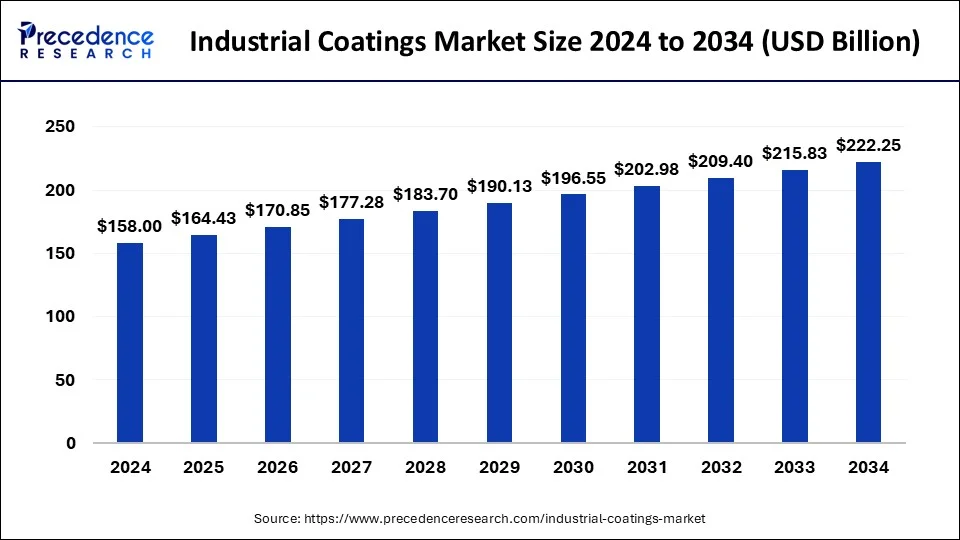
The global industrial coatings market is witnessing strong momentum, projected to grow significantly over the next decade, driven by rapid industrialization, infrastructure expansion, and increasing emphasis on corrosion protection and durability. The market is expected to reach approximately USD 165 billion by 2034, expanding at a compound annual growth rate (CAGR) of around 4.5% from 2025 to 2034.
Industrial coatings play a critical role in enhancing product lifespan, improving resistance to harsh environments, and meeting regulatory standards, making them indispensable across industries such as automotive, marine, oil & gas, and construction.
Quick Insights That Define the Market Landscape
The industrial coatings market is projected to surpass USD 165 billion by 2034, reflecting steady long-term expansion.
Asia Pacific dominates the global market due to rapid industrialization and infrastructure investments.
Protective coatings remain the leading product segment, driven by corrosion resistance needs.
Water-based coatings are gaining strong traction due to environmental regulations and sustainability goals.
The construction sector continues to be the largest end-user, supported by urbanization and smart city initiatives.
Key players include AkzoNobel, PPG Industries, Sherwin-Williams, BASF SE, and Nippon Paint Holdings.
What Is Driving the Growth of the Industrial Coatings Market?
The growth of the industrial coatings market is primarily fueled by rising investments in infrastructure development, especially in emerging economies. Governments worldwide are focusing on large-scale construction projects, transportation networks, and energy infrastructure, all of which require durable and high-performance coatings.
Additionally, the automotive and aerospace sectors are increasingly adopting advanced coatings to enhance performance, reduce maintenance costs, and comply with environmental standards. The growing need for corrosion protection in oil & gas pipelines and marine equipment further accelerates demand.
MarketScope
| Report Coverage | Details |
| Market Size in 2025 | USD 164.43 Billion |
| Market Size in 2026 | USD 170.85 Billion |
| Market Size by 2035 | USD 228.68 Billion |
| Growth Rate from 2026 to 2035 | CAGR of 3.35% |
| Largest Market | Asia Pacific |
| Base Year | 2025 |
| Forecast Period | 2026 to 2035 |
| Segments Covered | By Technology, By Product, and By End-User, and region |
| Regions Covered | North America, Europe, Asia-Pacific, Latin America, and Middle East & Africa |
How Is Artificial Intelligence Transforming the Industrial Coatings Market?
Artificial intelligence (AI) is reshaping the industrial coatings landscape by optimizing formulation processes and improving product performance. AI-driven simulations allow manufacturers to predict coating behavior under various environmental conditions, reducing trial-and-error in R&D and accelerating innovation cycles.
Moreover, AI-powered predictive maintenance tools are helping industries monitor coating degradation in real time, enabling timely interventions and extending asset lifespan. This not only reduces operational costs but also enhances safety and compliance across industries.
Market Growth Factors
The industrial coatings market is benefiting from a combination of macroeconomic and technological factors. Rapid urbanization, particularly in Asia Pacific and Latin America, is creating sustained demand for protective and decorative coatings.
Environmental regulations are also playing a crucial role, pushing manufacturers toward low-VOC and water-based formulations. At the same time, advancements in nanotechnology and smart coatings are opening new avenues for high-performance applications, including self-healing and anti-microbial coatings.
What Opportunities and Trends Are Shaping the Future of the Market?
Is Sustainability Becoming a Key Competitive Advantage?
Yes, sustainability is emerging as a major differentiator. Companies are investing heavily in eco-friendly coatings, including water-based and powder coatings, to meet stringent environmental regulations and consumer expectations.
Are Smart Coatings the Next Big Innovation?
Smart coatings with self-healing, anti-corrosion, and temperature-resistant properties are gaining traction, particularly in aerospace and defense applications.
How Is Renewable Energy Creating New Demand?
The expansion of wind and solar energy projects is driving demand for specialized coatings that can withstand extreme environmental conditions and enhance equipment durability.
Market Dynamics
Market Drivers
1. Rising Investments and Strategic Expansion
Major players such as PPG Industries Inc., Sherwin-Williams Company, BASF SE, AkzoNobel N.V., and Asian Paints Limited are actively strengthening their market presence through investments, partnerships, mergers, and new product launches. These strategies are playing a key role in driving overall market growth.
For example, PPG entered a four-year agreement in 2020 to supply eco-friendly paint products for thousands of residential properties across multiple U.S. states. Such collaborations highlight how companies are scaling operations while aligning with sustainability goals.
In emerging economies like India, industrial expansion is also fueling demand. Asian Paints, for instance, partnered with the Gujarat government to significantly increase its production capacity, backed by major capital investment. This reflects the broader trend of capacity expansion in high-growth regions.
2. Growing Demand for Eco-Friendly Coatings
Sustainability has become a central focus in the coatings industry. Demand for environmentally friendly coatings—especially those with low or zero volatile organic compounds (VOCs)—has surged.
Today, companies are not just reducing emissions but also focusing on:
Energy efficiency
Waste reduction
Use of renewable resources
Process optimization
Regulatory pressure and consumer awareness are accelerating this shift. As a result, manufacturers are increasingly adopting greener technologies and sourcing sustainable materials across the value chain.
3. Expanding Applications Across Industries
Industrial coatings are widely used across sectors such as automotive, aerospace, construction, marine, and manufacturing. Their primary role is to protect surfaces from corrosion, wear, and environmental damage.
These coatings can be applied to materials like metal, wood, concrete, plastic, and glass. With continuous innovation, new applications are emerging, especially in construction and infrastructure projects, where durability and performance are critical.
4. Rising Demand for Customized Automotive Coatings
The automotive sector is witnessing growing demand for customized and high-performance coatings. Consumers increasingly prefer vehicles with enhanced aesthetics, unique textures, and advanced finishes.
Technological advancements—such as special pigments that change color based on viewing angle—are improving both appearance and functionality. At the same time, stricter emission regulations are pushing manufacturers to adopt cleaner and more efficient coating processes.
Market Restraints
1. Health and Environmental Concerns (VOCs)
Industrial coatings often contain VOCs, which can pose serious health risks and contribute to environmental pollution. These substances easily evaporate into the air, making them hazardous for workers and surrounding communities.
Many solvents used in coatings are:
Toxic
Flammable
Potentially carcinogenic
As a result, regulatory bodies are enforcing stricter standards. For instance, frameworks like REACH in Europe and new U.S. regulations are limiting the use of harmful chemicals, increasing compliance costs for manufacturers.
2. Rising Raw Material Costs
Fluctuating and increasing prices of raw materials—such as resins, pigments, and additives—are putting pressure on the industry.
Supply chain disruptions, environmental policies, and global uncertainties have made raw material availability unpredictable. This has led to:
Increased production costs
Reduced profit margins
Price hikes (in some cases up to 60%)
Ultimately, these challenges are affecting demand and slowing market growth.
Market Opportunities
Growth in Shipbuilding and Pipeline Sectors
Powder coatings are gaining traction, especially in industries like shipbuilding and pipelines. These coatings are applied using electrostatic processes and offer strong durability and environmental benefits.
In marine environments, coatings must withstand extreme conditions. Advanced materials such as:
Zinc coatings (for corrosion protection)
Polyurethane (for durability and finish)
Powder coatings (for eco-compliance)
are increasingly preferred over traditional options.
Emerging markets in Asia-Pacific and South America present strong opportunities for growth in this segment.
Segment Insights
Technology Trends
Solvent-based coatings currently dominate the market due to their durability and quick drying time.
Water-based coatings are expected to grow faster because of their lower environmental impact.
Powder coatings are gaining popularity due to regulatory advantages and performance benefits.
Product Trends
Acrylic coatings lead the market due to their versatility and strong resistance properties (UV, weather, abrasion).
Fluoropolymer coatings are expected to grow the fastest, driven by their exceptional resistance to heat, chemicals, and harsh environments.
End-User Insights
The general industrial sector holds the largest share, driven by demand for durable and protective coatings.
However, the electronics sector is expected to grow the fastest due to:
Miniaturization of devices
Need for heat and moisture protection
Expansion of technologies like 5G and electric mobility
Regional Analysis
Asia-Pacific
Asia-Pacific dominates the market, driven by:
Rapid industrialization
Low-cost labor and materials
Expanding automotive manufacturing
Countries like China and India are key growth engines, supported by infrastructure development and government initiatives.
Europe
Growth in Europe is supported by:
Strong demand from automotive and aerospace sectors
Focus on sustainable coatings
Technological advancements like nanocoatings and self-healing materials
North America
North America remains a mature yet innovative market, led by the U.S. Key drivers include:
Advanced manufacturing
Strict environmental regulations
Growing adoption of eco-friendly coatings
Latin America
Countries like Brazil and Mexico are emerging markets, supported by infrastructure development and industrial expansion, though economic volatility remains a challenge.
Middle East & Africa
Growth in this region is driven by:
Infrastructure development
Oil & gas projects
Demand for corrosion-resistant coatings in harsh climates
Other Companies
- The Sherwin-Williams Company
- Akzo Nobel N.V.
- PPG Industries, INC.
- Hempel A/S
Segments Covered in the Report
By Technology
- Powder Based
- Solvent Borne
- Water-Borne
- Others
By Product
- Epoxy
- Acrylic
- Alkyd
- Polyurethane
- Polyester
- Others
By End-user
- Electronics
- Aerospace
- General Industrial
- Marine
- Mining
- Power Generation
- Automotive & Vehicle Refinish
- Oil & Gas
- Others
By Regional Outlook
- North America
- U.S.
- Canada
- Europe
- U.K.
- Germany
- France
- Asia Pacific
- China
- India
- Japan
- South Korea
- Middle East & Africa
- Latin America
Get Sample Link: https://www.precedenceresearch.com/sample/1048
Also Read : https://www.businesswebwire.com/precision-fermentation-market/

- Corporate Wellness Market Surges Toward USD 500.09 Billion by 2035 - April 22, 2026
- Portable Medical Devices Market Surges Toward USD 221.71 Billion by 2035 - April 22, 2026
- Infant Incubator Market Set to Surpass USD 3.27 Billion by 2035 - April 22, 2026