
Market poised for robust growth driven by rising demand for visually appealing, high-quality food products and natural ingredients
The global food glazing agents market is set for significant growth, with an estimated market size of USD 5.21 billion in 2025 projected to nearly double to USD 10.74 billion by 2034. This growth is forecasted at a compound annual growth rate (CAGR) of 8.36% from 2025 to 2034, fueled by increasing consumer demand for visually appealing, fresh-looking, and shelf-stable food products across confectionery, bakery, snacks, and pharmaceuticals sectors.
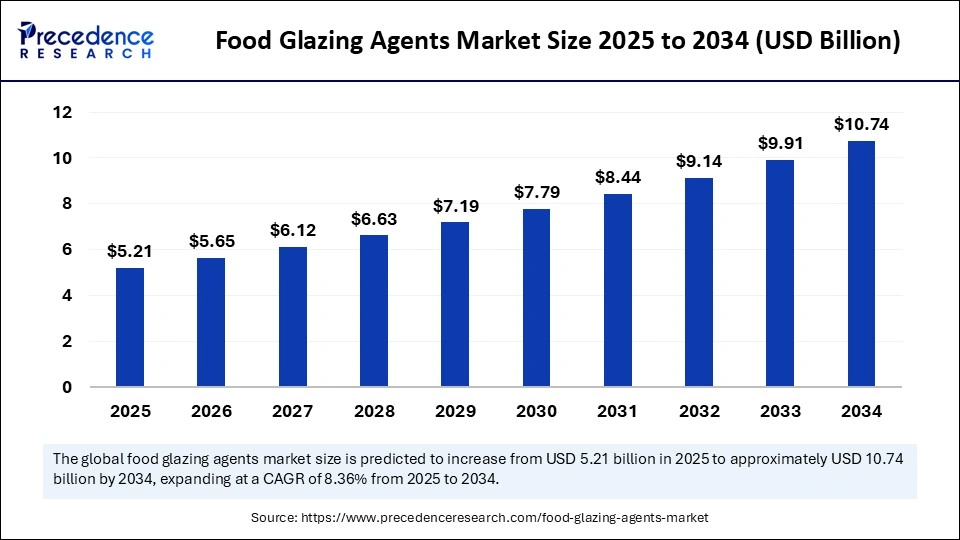
Food Glazing Agents Market Key Insights
-
North America leads the food glazing agents market, contributing the highest market share of 35% in 2024.
-
The Asia Pacific region is the fastest-growing, expected to exhibit significant CAGR from 2025 to 2034.
-
Natural glazing agents dominate the product segment with a 40% market share as of 2024.
-
Specialty functional coatings are the fastest-growing product subtype, driven by multifunctional benefits.
-
Confectionery products represent the largest application segment, capturing 35% of the market.
-
Pharmaceutical and nutraceutical applications are rapidly expanding, reflecting a growing health-conscious consumer base.
-
Liquid/syrup-based formulations hold a 40% share, favored for their clean-label appeal.
-
Conventional/synthetic glazing agents still dominate with 70% market share, though organic/clean-label segments are growing robustly.
-
Confectionery manufacturers represent the largest end-user group with a 30% share.
-
North America and Europe set the benchmark for technology and sustainability, while Asia Pacific emerges as a high-growth market hub.
What Are Food Glazing Agents and Why Are They Key to Market Growth?
Food glazing agents are specialized ingredients applied to the surface of food products to enhance their appearance, extend shelf life, prevent moisture loss, and modify texture. They range from natural waxes such as carnauba and beeswax to synthetic compounds and multifunctional coatings. These agents are essential in confectionery to maintain gloss, in bakery to provide a premium finish, and in pharmaceuticals for tablet coatings that improve swallowability and stability.
The growing consumer preference for convenience-ready, visually superior, and natural food items propels the market demand. Additionally, stringent food safety regulations and sustainability goals encourage manufacturers to innovate with bio-based, clean-label glazing materials that align with ethical and environmental values.
Food Glazing Agents Market Growth Factors
Key growth drivers include:
-
Rising disposable incomes and consumer demand for packaged, premium-quality foods.
-
Expanding confectionery, bakery, and processed foods industries overall.
-
Heightened focus on product differentiation through appearance and texture enhancement.
-
Regulatory trends favoring natural, non-toxic, and sustainable ingredient sources.
-
Technological advances in coatings and application machinery boosting efficiency and product performance.
-
Increasing health awareness fostering growth in pharmaceutical and nutraceutical glazing applications.
How Is AI Influencing the Food Glazing Agents Market?
Artificial intelligence (AI) is playing an emerging yet meaningful role in the food glazing agents market by optimizing formulation development and manufacturing processes. AI-powered predictive analytics help companies better tailor glazing agents to specific food types, climatic conditions, and consumer preferences, enabling more precise customization and higher product quality.
In manufacturing, AI-enabled automation streamlines application methods such as spraying and enrobing, reducing waste and improving coating uniformity. Additionally, AI supports quality control through real-time monitoring systems, ensuring consistency and compliance with stringent food safety standards, thereby accelerating innovation cycles in the market.
Food Glazing Agents Market Scope
| Report Coverage | Details |
| Market Size in 2025 | USD 5.21 Billion |
| Market Size in 2026 | USD 5.65 Billion |
| Market Size by 2034 | USD 10.74 Billion |
| Market Growth Rate from 2025 to 2034 | CAGR of 8.36% |
| Dominating Region | North America |
| Fastest Growing Region | Asia Pacific |
| Base Year | 2024 |
| Forecast Period | 2025 to 2034 |
| Segments Covered | Product Type, Application, Nature, Formulation, End-User / Customer Segment, and Region |
| Regions Covered | North America, Europe, Asia-Pacific, Latin America, and Middle East & Africa |
What Opportunities and Trends Are Shaping the Food Glazing Agents Market?
-
Why are natural glazing agents gaining dominance?
Consumers’ preference for clean-label, organic, and eco-friendly food products drives the adoption of natural agents like carnauba wax and beeswax. These ingredients offer biodegradable, non-toxic attributes while meeting regulatory and sustainability requirements. -
What innovations are emerging in specialty coatings?
Specialty functional coatings incorporating moisture barriers, anti-caking properties, and flavor encapsulation are enhancing product shelf life and sensory appeal, offering added value beyond traditional glazing. -
How is regional growth influencing market dynamics?
Developed markets such as North America and Europe focus on product innovation and sustainability, while Asia Pacific’s rapid urbanization and growing middle-class populations fuel high growth, especially in confectionery and bakery sectors. -
What role do customization and tailor-made coatings play?
Brands increasingly seek custom formulations to differentiate products with specific textures or finishes, driving the growth of tailor-made glazing solutions adapted for premium and specialized food items.
Challenges and Cost Pressures
Despite growth opportunities, the market faces challenges such as:
-
High costs associated with natural and organic glazing agents compared to synthetic equivalents.
-
Technical complexities in formulating multifunctional coatings with consistent performance.
-
Regulatory compliance and food safety standards adding operational pressures.
-
Supply chain constraints for key raw materials like carnauba and beeswax impacting availability and pricing.
Regional Market and Segmentation Insights
-
North America: Leading with a 35% share due to well-established food processing industries in the U.S. and Canada emphasizing innovation and clean-label products; the U.S. market alone is projected to grow at 8.44% CAGR through 2034.
-
Asia Pacific: Fastest growing region spearheaded by China, India, and Japan with expanding food manufacturing, urbanization, and evolving consumer dietary habits.
-
Europe: Growing demand for organic and premium food products supports steady market expansion; Germany is a key player focusing on sustainable glazing technologies.
Segmental Analysis
| Segment | Key Insight |
|---|---|
| Product Type | Natural agents hold 40% share; specialty coatings fastest growing at 10% CAGR |
| Application | Confectionery leads with 35%; pharmaceuticals fastest growing at 7% CAGR |
| Formulation | Liquid/syrup-based dominate (40%); custom coatings growing rapidly |
| Nature | Conventional/synthetic dominate (70%); organic segment rapidly growing |
| End-User | Confectionery manufacturers largest group (30%); bakery and snacks growing fast |
Leading global companies advancing the market include:
-
Cargill
-
ADM
-
Ingredion
-
Kerry Group
-
Givaudan
-
IFF (International Flavors & Fragrances)
-
Tate & Lyle
-
Corbion
-
AAK
-
Dohler Group
-
Sensient
-
Kalsec
-
Kemin
These firms are innovating sustainable, bio-based glazing agents and investing in automated application technologies to boost efficiency and meet consumer clean-label demands.
Food Glazing Agents Market Segments Covered in the Report
By Product Type
- Natural Glazing Agents
- Carnauba Wax
- Beeswax
- Shellac
- Synthetic / Modified Glazing Agents
- Hydrogenated Vegetable Oils
- Resin-Based Coatings
- Emulsion-Based Coating
- Water-Based Glazes
- Oil-In-Water Emulsions
- Glyceride-Based / Fat-Based Coatings
- Mono- And Diglycerides
- Specialty Lipid Coatings
- Specialty Functional Coatings
- Anti-Caking / Moisture Barrier
- Flavor / Aroma Encapsulation
By Application
- Confectionery Products
- Chocolates & Candy
- Coated Nuts
- Bakery Product
- Bread & Pastries
- Cakes & Cookies
- Fruits & Vegetable
- Fresh-Cut Fruits
- Processed / Dried Fruits
- Snacks & Savory Food
- Chips & Extruded Snacks
- Nuts & Seeds
- Pet Food & Feed
- Dry Pet Food
- Treats & Supplements
- Pharmaceuticals/Nutraceuticals
- Tablets & Capsules
- Nutraceutical Coatings
By Formulation
- Liquid / Syrup-Based
- Powder / Dry Coatings
- Paste / Gel-Based Coatings
- Spray / Aerosol-Ready Formulations
- Custom / Tailor-Made Coatings
By Nature
- Organic / Clean-Label
- Conventional / Synthetic
By End User / Customer Segment
- Confectionery Manufacturers
- Bakery & Snack Manufacturers
- Fruit & Vegetable Processors
- Pet Food Manufacturers
- Pharmaceutical & Nutraceutical Companies
- Co-Packers & Contract Manufacturers
- Retail / Food Service Applications
By Region
- North America
- Europe
- Asia Pacific
- Latin America
- Middle East & Africa
Get this report to explore global market size, share, CAGR, and trends, featuring detailed segmental analysis and an insightful competitive landscape overview @ https://www.precedenceresearch.com/sample/7085
You can place an order or ask any questions. Please feel free to contact us at [email protected] |+1 804 441 9344

- ESG Software Market 2025: Comprehensive Company Ecosystem and Revenue Overview - May 20, 2026
- ESG Software Market Surges Toward USD 31.96 Billion by 2035 as AI-Powered Compliance and Sustainability Reporting Transform Global Enterprises - May 20, 2026
- Hematopoietic Stem Cell Transplantation Market Surges Toward USD 24.32 Billion by 2035 as Precision Medicine and AI Reshape Blood Cancer Treatment - May 20, 2026